Learn what every symbol on the card means.Full credits and sources at beakbrain.com/symbols
 ForestDomed nestMedium · 96 g
ID tip
Male band-tailed caciques average about 33 cm (13 in) long and 118 g (4.2 oz). Females average about 24.5 cm (9.6 in) long and 75 g (2.6 oz). The sexes have essentially the same plumage though females are a duller black than males. Adults are mostly velvety black. Their crown, nape, and upper back are chestnut and their wings have a bluish gloss. Their central tail feathers are black and the rest are yellow with black tips. They have a pale blue iris and black legs and feet. Their bill can be ivory-colored with a dusky wash on the tip or have a dusky gray maxilla and an ivory mandible. Voice: The band-tailed cacique's song is "a fairly short twanging ka'CHAWWW or CHOOO interspersed with higher rusty squeaks". Its calls are "rich, throaty g'luck, rhaw, and chaw notes".
Text from Wikipedia, licensed CC BY-SA 4.0.
When to see the Band-tailed Cacique
One bar for each month. Filled bars are the 10 months with records; pale bars are months with none. The wide bar is July, the month with the most records.
Where to see the Band-tailed Cacique
The map shades 2 countries with regular records, and 2 more in a lighter tone where the bird turns up only as a stray. Everything unshaded has no records. Countries are listed below the map.
About the Band-tailed Cacique
The band-tailed cacique is a species of bird in the family Icteridae, the oropendolas, New World orioles, and New World blackbirds. It is found in Brazil, Colombia, Ecuador, and Peru.
Text adapted from Wikipedia, licensed CC BY-SA 4.0.
Easily confused with
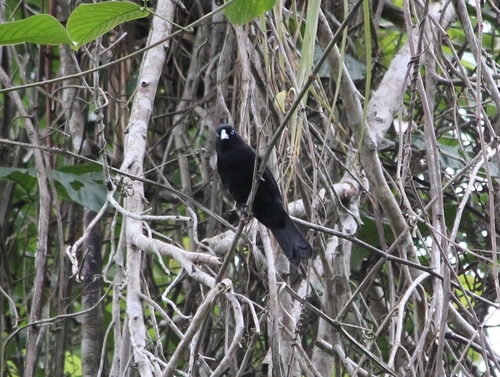 Ecuadorian CaciqueCacicus sclateriThe male Ecuadorian cacique grows to a length of about 23 cm (9 in), with the female being a little smaller.
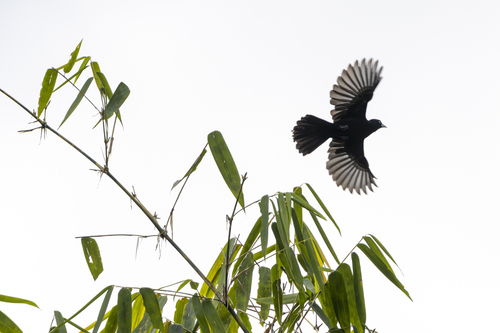 Selva CaciqueCacicus koepckeaeThe Selva cacique is entirely black except for a distinctive yellow rump and yellow upper-tail coverts.
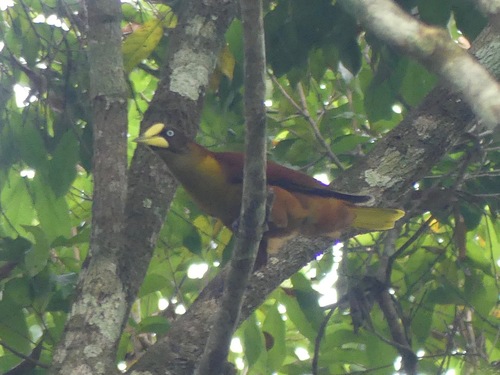 Casqued CaciqueCacicus oseryiMale casqued caciques average 37 cm (15 in) long and 188 g (6.6 oz).
Learn the Band-tailed Cacique in the BeakBrain App
Photo and call practice. Coming soon to iPhone and Android.
Play today's Daily BirdEvery photo and recording on this page is credited to its author under the licence shown. Spotted a problem with this page, or have a better photo? Contribute.