Learn what every symbol on the card means.Full credits and sources at beakbrain.com/symbols
 ForestSmall · 50 g
ID tip
The duchess lorikeet is 20 cm (8 in) in length, and weighs 40–60 g (1.4–2.1 oz). An adult is mainly bright red, with purple to black hindcrowns and yellow-orange eyes. It has an orange bill and a wide yellow chest band along with a thin yellow collar on the mantle bordered by a purple or black line. It has a dull mauve to black lower breast, with dull yellow underwings. Its tail are red, with green upper tail coverts and yellow tips. Females look the same as males, but additionally have yellow patches on the side of the rump.
Text from Wikipedia, licensed CC BY-SA 4.0.
When to see the Duchess Lorikeet
One bar for each month. Filled bars are the 11 months with records; pale bars are months with none. The wide bar is July, the month with the most records.
Where to see the Duchess Lorikeet
The map shades 13 countries with regular records, and 5 more in a lighter tone where the bird turns up only as a stray. Everything unshaded has no records. Countries are listed below the map.
Recorded as a rare visitor in France, Germany, United States, Australia, Indonesia.
About the Duchess Lorikeet
The duchess lorikeet is a species of parrot in the family Psittaculidae. It is found throughout the Solomon Islands archipelago. Its natural habitats are subtropical or tropical moist lowland forest, subtropical or tropical moist montane forest, and plantations. It is threatened by habitat loss.
Text adapted from Wikipedia, licensed CC BY-SA 4.0.
Easily confused with
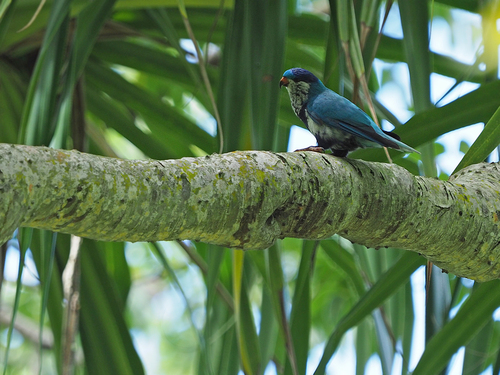 Ultramarine LorikeetVini ultramarinaThe ultramarine lorikeet is a species of parrot in the family Psittaculidae, endemic to the Marquesas Islands.
 Stephen's LorikeetVini stepheniThe lorikeets are 19 cm (7.5 in) in length and weigh 42–55 g (1.5–1.9 oz).
 Palm LorikeetVini palmarumThe palm lorikeet is a species of parrot in the family Psittaculidae.
Learn the Duchess Lorikeet in the BeakBrain App
Photo and call practice. Coming soon to iPhone and Android.
Play today's Daily BirdEvery photo and recording on this page is credited to its author under the licence shown. Spotted a problem with this page, or have a better photo? Contribute.