Learn what every symbol on the card means.Full credits and sources at beakbrain.com/symbols
 CoastalGround nest


ID tip
The double-banded plover is distinguished by a dark, grey-brown back with a distinctive white chest and a thin band of black situated just below the neck running across the chest along with a larger brown band underneath. During breeding season, these bands are more dominantly shown on the males compared to females. Younger birds have no bands, and are often speckled brown on top, with less white parts. These shorebirds have relatively long legs to allow them to easily wade around shallow waters and move efficiently around sandy beaches.
Text from Wikipedia, licensed CC BY-SA 4.0.
About the Double-banded Plover
The double-banded plover, known as the banded dotterel or pohowera in New Zealand, is a species of bird in the plover family. Two subspecies are recognised: the nominate Anarhynchus bicinctus bicinctus, which breeds throughout New Zealand, including the Chatham Islands, and A. b. exilis, which breeds in New Zealand's subantarctic Auckland Islands.
Text adapted from Wikipedia, licensed CC BY-SA 4.0.
Easily confused with
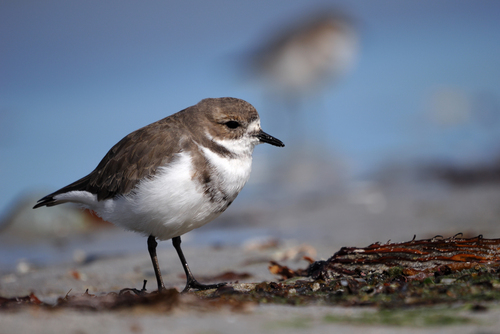 Two-banded PloverAnarhynchus falklandicusThe two-banded plover is 17 to 19 cm (6.7 to 7.5 in) long and weighs 62 to 72 g (2.2 to 2.5 oz).
 White-fronted PloverAnarhynchus marginatusThe average white-fronted plover weighs approximately 45-50 g, and the two sexes differ slightly in plumage coloration.
 Malaysian PloverAnarhynchus peroniiThe Malaysian plover is 15 cm (5.9 in) in length.
Side by side: Double-banded Plover vs Two-banded Plover · Double-banded Plover vs White-fronted Plover · Double-banded Plover vs Malaysian Plover
Learn the Double-banded Plover in the BeakBrain App
Photo and call practice. Coming soon to iPhone and Android.
Play today's Daily BirdEvery photo and recording on this page is credited to its author under the licence shown. Spotted a problem with this page, or have a better photo? Contribute.