
Double-banded Plover
Anarhynchus bicinctus
The double-banded plover is distinguished by a dark, grey-brown back with a distinctive white chest and a thin band of black situated just below the neck running across the chest along with a larger brown band underneath. During breeding season, these bands are more dominantly shown on the males compared to females. Younger birds have no bands, and are often speckled brown on top, with less white parts. These shorebirds have relatively long legs to allow them to easily wade around shallow waters and move efficiently around sandy beaches.
ID text from Wikipedia, CC BY-SA 4.0
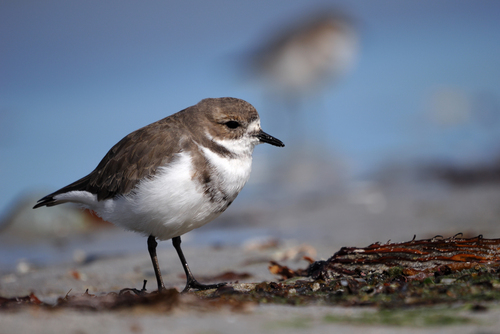
Two-banded Plover
Anarhynchus falklandicus
The two-banded plover is 17 to 19 cm (6.7 to 7.5 in) long and weighs 62 to 72 g (2.2 to 2.5 oz). It has a potbellied appearance and its bill and legs are black. Adult males in breeding have a white forehead, lower face, breast, and belly. They have a black bar on the forecrown and a chestnut crown and hindneck. Their upperparts are brown. They have two black breastbands, the upper one of which is frequently incomplete. (This feature is more prevalent in the Falklands population. Voice: What is believed to be the two-banded plover's display song is "a repeated phrase of 2–3 mellow notes followed by a gravelly trill, e.g. 'whit-whit-whitrrrrrrt'." Frequently heard calls are "a short emphatic 'pit' or mellower 'whit'."
ID text from Wikipedia, CC BY-SA 4.0
Learn this pair in the BeakBrain App
Photo and call practice. Coming soon to iPhone and Android.
Play today's Daily BirdPhotos and recordings are credited to their authors under the licence shown. Full profiles: Double-banded Plover and Two-banded Plover.