Learn what every symbol on the card means.Full credits and sources at beakbrain.com/symbols
 GrasslandCup nestSmall · 26 g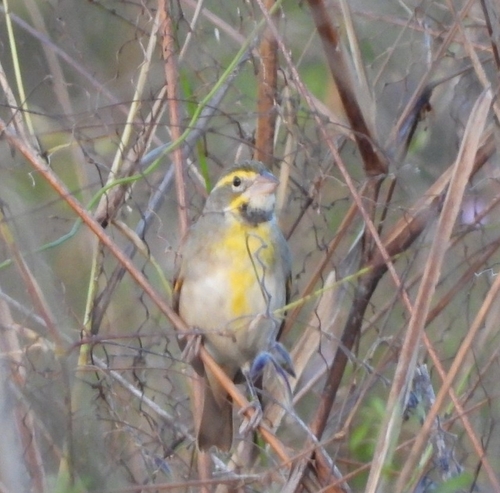


What the Dickcissel sounds like


ID tip
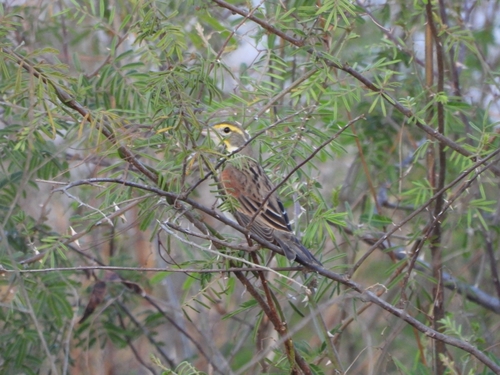
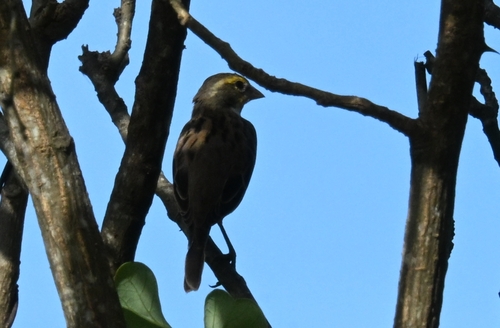
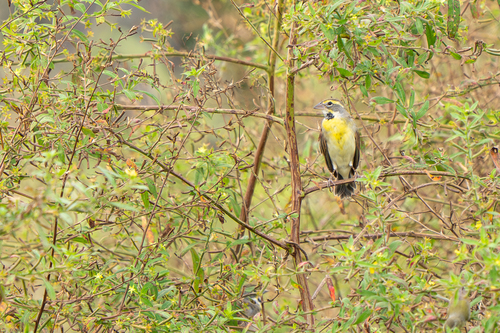
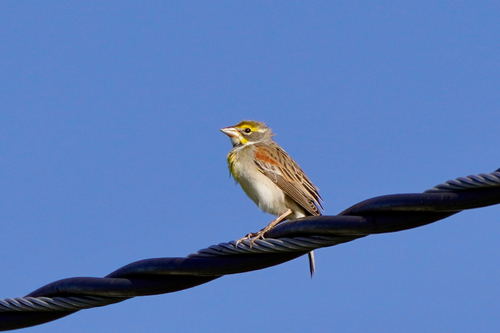
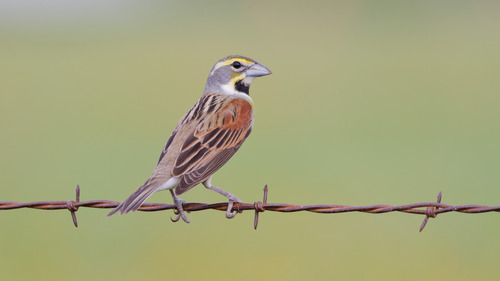
Their length is 5.5–6.3 in (140–160 mm), wingspan is 9.8–10.2 in (250–260 mm), and weight is0.9–1.4 oz (26–40 g). Dickcissels have a large, pale bill, a yellow line over the eyes, brownish upperparts with black streaks on the back, dark wings, a rust patch on the shoulders, and light underparts. Adult males have a black throat patch, a yellow breast, and grey cheeks and crown. This head and breast pattern is especially brilliant in the breeding plumage, making it resemble an eastern meadowlark.
Text from Wikipedia, licensed CC BY-SA 4.0.
When to see the Dickcissel
One bar for each month. Filled bars are the 7 months with records; pale bars are months with none. The wide bar is June, the month with the most records.
Where to see the Dickcissel
The map shades 24 countries with regular records, and 3 more in a lighter tone where the bird turns up only as a stray. Everything unshaded has no records. Countries are listed below the map.
About the Dickcissel
The dickcissel is a small seed-eating migratory bird in the family Cardinalidae. It breeds on the prairie grasslands of the Midwestern United States and winters in Central America, northern Colombia, and northern Venezuela. It is the only member of the genus Spiza, though some sources list another supposedly extinct species.
Text adapted from Wikipedia, licensed CC BY-SA 4.0.
Easily confused with
 Lazuli BuntingPasserina amoenaMeasurements:
Length: 5.1–5.9 in (13–15 cm)
Weight: 0.5–0.6 oz (13–18 g)
Wingspan: 8.7 in (22 cm)
The male is easily recognized by its bright blue head and back (lighter than the closely related indigo bunting), its conspicuous white wingbars, and its light rusty breast and white belly.
Lazuli BuntingPasserina amoenaMeasurements:
Length: 5.1–5.9 in (13–15 cm)
Weight: 0.5–0.6 oz (13–18 g)
Wingspan: 8.7 in (22 cm)
The male is easily recognized by its bright blue head and back (lighter than the closely related indigo bunting), its conspicuous white wingbars, and its light rusty breast and white belly.
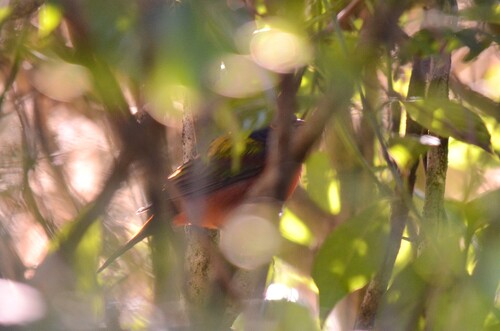 Painted BuntingPasserina cirisThe male painted bunting is often described as the most beautiful bird in North America and as such has been nicknamed nonpareil, or "without equal".
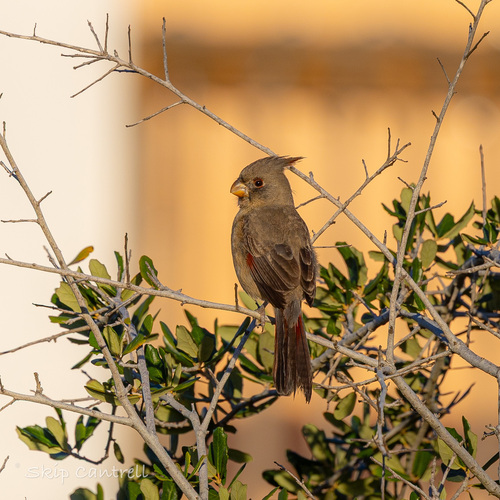 PyrrhuloxiaCardinalis sinuatusThe desert cardinal is a medium-sized song bird; the length for both sexes is about 8.3 in (21 cm), while the typical weight is 0.8–1.5 oz (24–43 g).
Side by side: Dickcissel vs Lazuli Bunting · Dickcissel vs Painted Bunting · Dickcissel vs Pyrrhuloxia
Learn the Dickcissel in the BeakBrain App
Photo and call practice. Coming soon to iPhone and Android.
Play today's Daily BirdEvery photo and recording on this page is credited to its author under the licence shown. Spotted a problem with this page, or have a better photo? Contribute.