Learn what every symbol on the card means.Full credits and sources at beakbrain.com/symbols
 ShrublandCup nestMedium · 81 g


ID tip
The curve-billed thrasher is immediately recognized as a thrasher by its long tail and short wings. It is also recognized for its sickle-shaped bill, almost as long as its head width and brownish black in color. The body is compact with a large head, short wings and long tail. However, the tail is short relative to other thrasher species. The chest is grayish brown with circular brown-gray spots. The eyes are generally orange, shading to golden in adulthood. Juveniles are lacking in pale tips, rectrices, abdominal feathers are unkempt and upper parts and chest are washed rufously.
Text from Wikipedia, licensed CC BY-SA 4.0.
When to see the Curve-billed Thrasher
One bar for each month, and every month is filled: this bird is recorded here in all twelve. The wide bar is April, the month with the most records.
Where to see the Curve-billed Thrasher
The map shades 2 countries with regular records, and 1 more in a lighter tone where the bird turns up only as a stray. Everything unshaded has no records. Countries are listed below the map.
Recorded as a rare visitor in Canada.
About the Curve-billed Thrasher
The curve-billed thrasher is a medium-sized mimid native to most of Mexico and to the deserts of southwestern United States. It is a non-migratory species, and throughout most of its range it is the most common desert thrasher. Several subspecies have been classified since 1827, though there is no consensus on the number. Allopatric speciation is believed to have played a major role in the variations of the curve-billed. It is grey-brown overall with a slightly curved bill, and is similar in appearance to the related Bendire's thrasher. It generally resides in desert regions of the United States and Mexico, but can inhabit areas predominately populated by humans.
Text adapted from Wikipedia, licensed CC BY-SA 4.0.
Easily confused with
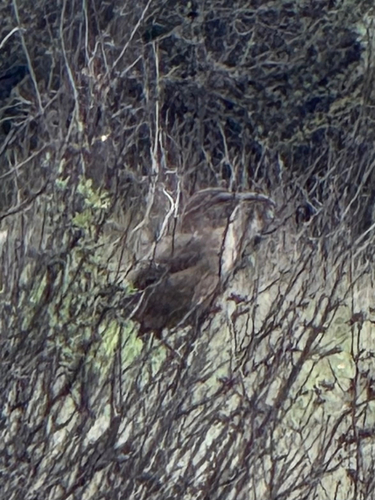 California ThrasherToxostoma redivivumThe California thrasher is about 32 cm (13 in) long and weighs up to 90 g (3.2 oz); it is the largest thrasher.
 Long-billed ThrasherToxostoma longirostreThis bird is slender and long-tailed, averaging 26.5–29 cm (10.5–11.5 in) in length and about 70 g (2.5 oz) in weight.
 Crissal ThrasherToxostoma crissaleThe bird grows to 32 centimetres (13 in), and has a deeply curved bill.
Side by side: Curve-billed Thrasher vs Grey Catbird · Brown Thrasher vs Curve-billed Thrasher · California Thrasher vs Curve-billed Thrasher · Curve-billed Thrasher vs Long-billed Thrasher · Crissal Thrasher vs Curve-billed Thrasher
Learn the Curve-billed Thrasher in the BeakBrain App
Photo and call practice. Coming soon to iPhone and Android.
Play today's Daily BirdEvery photo and recording on this page is credited to its author under the licence shown. Spotted a problem with this page, or have a better photo? Contribute.