Learn what every symbol on the card means.Full credits and sources at beakbrain.com/symbols
 WoodlandPlatform nestLarge · 1.1 kg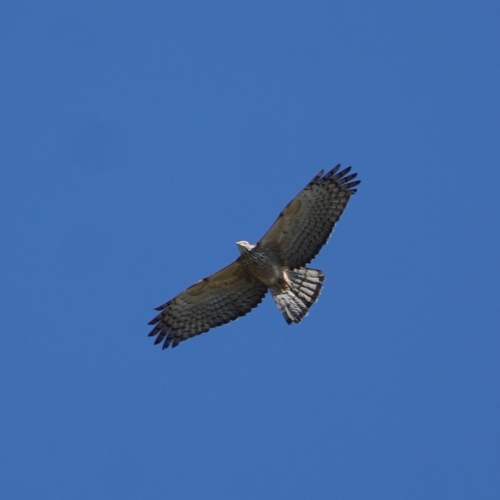
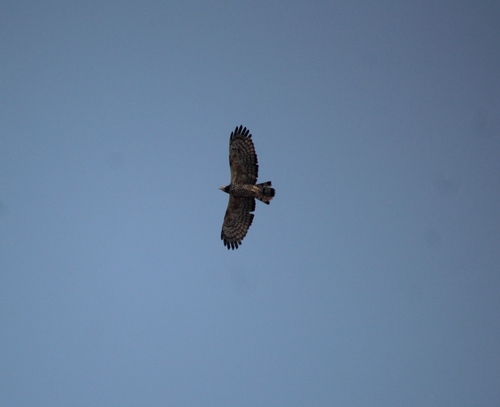
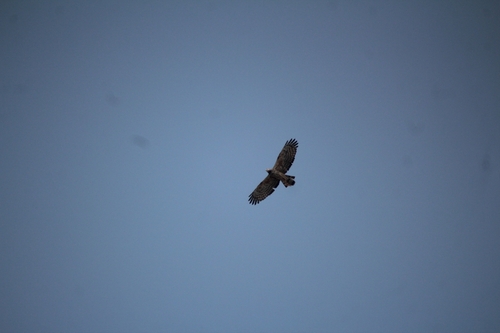


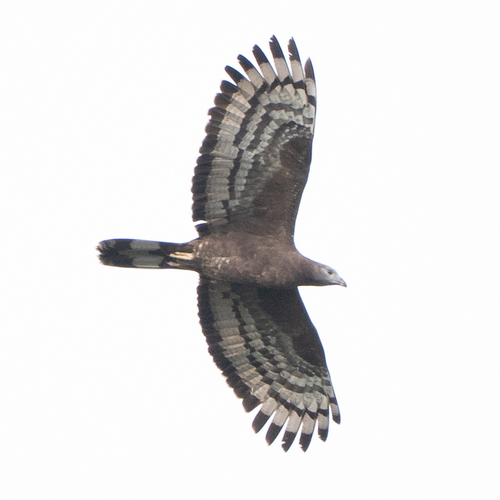
What the Crested Honey Buzzard sounds like

ID tip
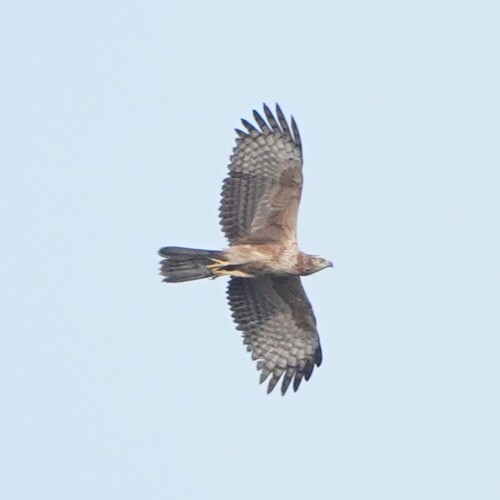
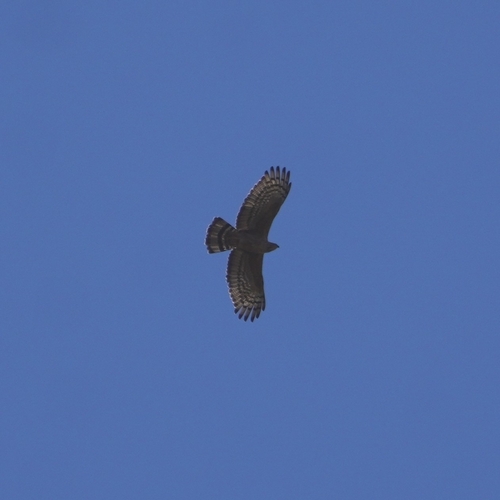
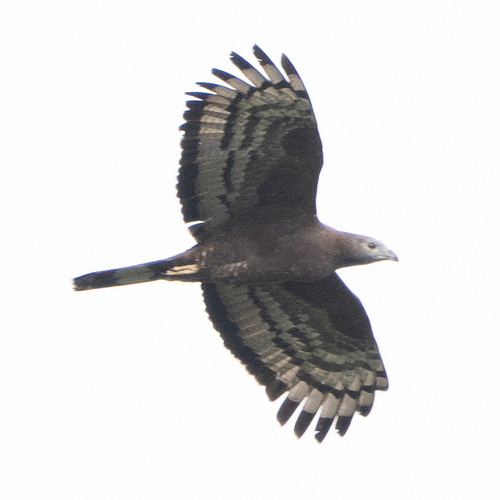
About 57–60 cm (22–24 in) in size, the crested honey buzzard is a fairly large raptor. The bird weighs 750 to 1,490 g (1.65 to 3.28 lb). The head lacks a strong superciliary ridge, giving it a facial appearance very unlike a raptor. It appears long-necked with a small head resembling that of a pigeon. It has a long tail and a short head crest. It is brown above, but not as dark as the European honey buzzard, and paler below. A dark throat stripe is present. Unusually for a large bird of prey, the sexes can be distinguished.
Text from Wikipedia, licensed CC BY-SA 4.0.
When to see the Crested Honey Buzzard
One bar for each month. Filled bars are the 10 months with records; pale bars are months with none. The wide bar is February, the month with the most records.
Where to see the Crested Honey Buzzard
The map shades 46 countries with regular records, and 3 more in a lighter tone where the bird turns up only as a stray. Everything unshaded has no records. Countries are listed below the map.
Recorded as a rare visitor in South Africa, Finland, Kenya.
About the Crested Honey Buzzard
The crested honey buzzard, also known as the Oriental, Asiatic, or Eastern honey buzzard, is a bird of prey in the family Accipitridae, which also includes many other diurnal raptors such as kites, eagles, and harriers. It is a fairly large raptor, larger than the European honey buzzard. The name honey buzzard is derived from their diets, which consist mainly of the larvae of bees and wasps extracted from honey combs. It is sexually dimorphic and has six subspecies.
Text adapted from Wikipedia, licensed CC BY-SA 4.0.
Easily confused with
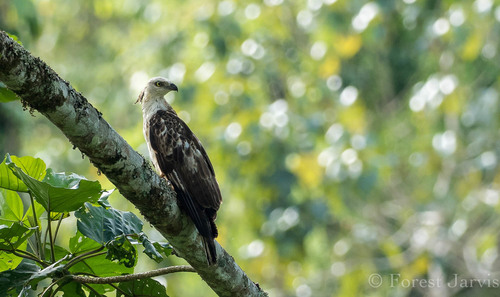 Philippine Honey BuzzardPernis steereiThe body ranges from 52.5 cm to 55.3 cm in males and 52 cm to 59 cm in females; the wingspan is 2.1 times total length.
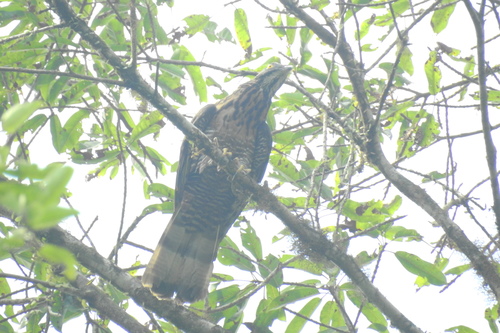 Barred Honey BuzzardPernis celebensisThe barred honey buzzard or Sulawesi honey buzzard is a species of bird of prey in the family Accipitridae.
 European Honey BuzzardPernis apivorusThe 52–60-centimetre (20–24 in)-long honey buzzard is larger and longer winged, with a 135–150-centimetre (53–59 in) wingspan, when compared to the smaller common buzzard (Buteo buteo).
Side by side: Crested Honey Buzzard vs European Honey Buzzard · Cinereous Vulture vs Crested Honey Buzzard
Learn the Crested Honey Buzzard in the BeakBrain App
Photo and call practice. Coming soon to iPhone and Android.
Play today's Daily BirdEvery photo and recording on this page is credited to its author under the licence shown. Spotted a problem with this page, or have a better photo? Contribute.