Learn what every symbol on the card means.Full credits and sources at beakbrain.com/symbols
 CoastalCavity nestLarge · 325 g


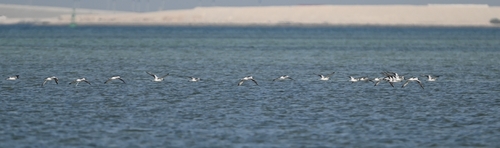
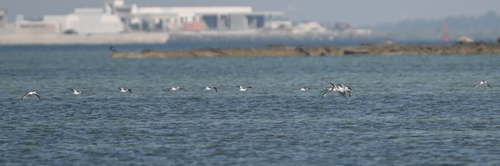
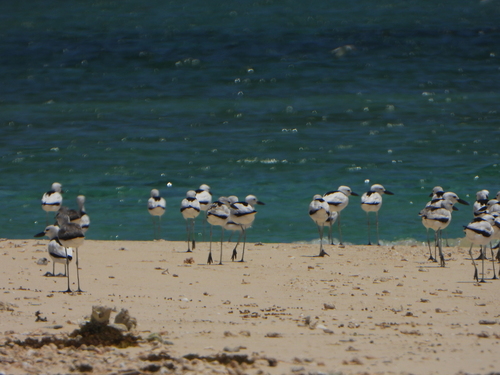
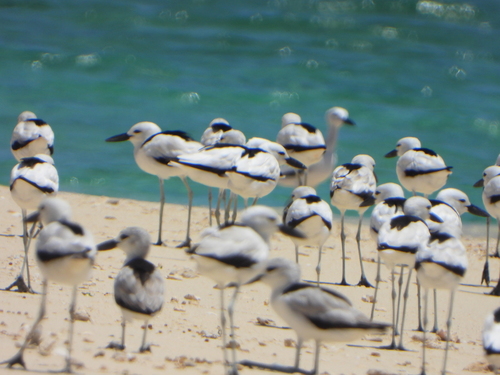

ID tip
This bird resembles a plover, but has very long grey legs and a strong heavy black bill similar to a tern. Its black-and-white plumage and long-necked upright posture with heavy bill makes it distinctive and unmistakable. Its bill is unique among waders, and specialised for eating crabs. It has partially webbed toes. The plumage is white except for black on its back and in the primary feathers of the wings. They are noisy birds, calling frequently on their breeding sites and in their wintering grounds. The usual call is a ka similar to that of the bar-tailed godwit but repeated rapidly.
Text from Wikipedia, licensed CC BY-SA 4.0.
When to see the Crab-plover
One bar for each month. Filled bars are the 10 months with records; pale bars are months with none. The wide bar is November, the month with the most records.
Where to see the Crab-plover
The map shades 26 countries with regular records, and 2 more in a lighter tone where the bird turns up only as a stray. Everything unshaded has no records. Countries are listed below the map.
About the Crab-plover
The crab-plover or crab plover is a coastal wader (shorebird). It is the only member of the genus Dromas and the family Dromadidae. It is unique among waders in making use of ground warmth to aid the incubation of its eggs. The crab-plover is classified in the suborder Lari, making it more closely related to gulls and auks than to most other waders such as plovers and sandpipers.
Text adapted from Wikipedia, licensed CC BY-SA 4.0.
Learn the Crab-plover in the BeakBrain App
Photo and call practice. Coming soon to iPhone and Android.
Play today's Daily BirdEvery photo and recording on this page is credited to its author under the licence shown. Spotted a problem with this page, or have a better photo? Contribute.