Learn what every symbol on the card means.Full credits and sources at beakbrain.com/symbols
 ForestCavity nestTiny · 12 g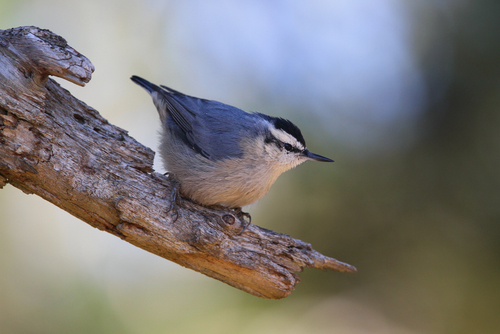


What the Corsican Nuthatch sounds like

ID tip
The Corsican nuthatch is the only nuthatch found in Corsica, however, it may be reminiscent of the coal tit (Periparus ater), which is common in Corsican forests and has similar markings on its head. The Eurasian nuthatch which inhabits nearby mainland France is larger, has no black on the crown and has yellow (or white for some subspecies) underparts tending to orange around the rump. Voice: The contact call is a light, whistling pu, which the bird repeats in series of five to six notes, in pupupupu. When agitated, this nuthatch emits a "rough and stretched, slowly repeated" pchèèhr, as might a common starling (Sturnus vulgaris), or a psch-psch-psch that turns into a chay-chay-chay or sch-wer, sch-wer when more agitated.
Text from Wikipedia, licensed CC BY-SA 4.0.
When to see the Corsican Nuthatch
One bar for each month. Filled bars are the 3 months with records; pale bars are months with none. The wide bar is May, the month with the most records.
Where to see the Corsican Nuthatch
The map shades 1 country with regular records. Everything unshaded has no records. Countries are listed below the map.
About the Corsican Nuthatch
The Corsican nuthatch is a species of bird in the nuthatch family Sittidae. It is a relatively small nuthatch, measuring about 12 cm (4.7 in) in overall length. The upperparts are bluish-grey, the underparts greyish-white. The male is distinguished from the female by its entirely black crown. The species is sedentary, territorial and not very shy. It often feeds high in Corsican pines, consuming mainly pine seeds, but also catching some flying insects. The breeding season takes place between April and May; the nest is placed in the trunk of an old pine, and the clutch has five to six eggs. The young fledge 22 to 24 days after hatching.
Text adapted from Wikipedia, licensed CC BY-SA 4.0.
Easily confused with
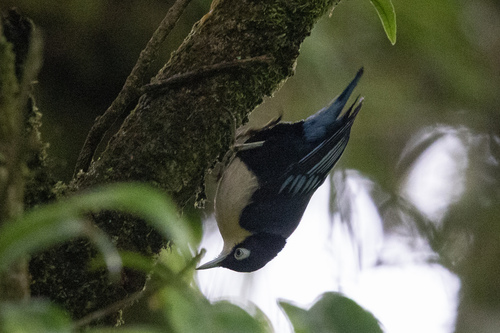 Blue NuthatchSitta azureaThe blue nuthatch is a medium-sized nuthatch that has an average length of 13.5 cm (5.3 in).
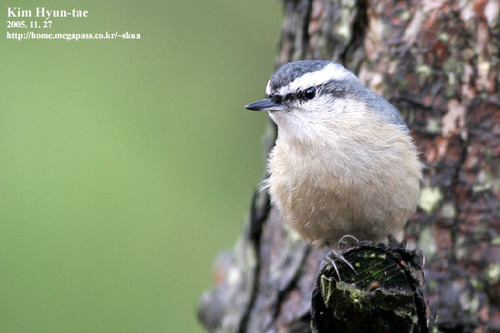 Chinese NuthatchSitta villosaThis species is locally found in sympatry with the Eurasian nuthatch (S. europaea), but differs from it in its smaller size, clearly visible white supercilium, black crown in males, and relatively plain underparts, lacking the reddish undertail coverts and flanks.
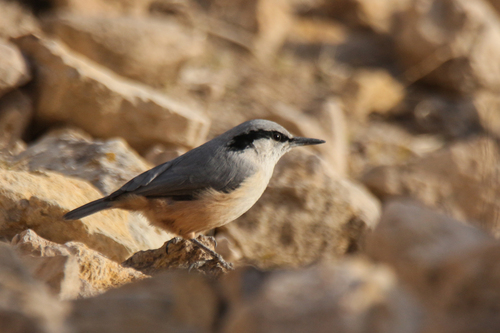 Eastern Rock NuthatchSitta tephronotaEastern rock nuthatch is 15–16 cm long.
Learn the Corsican Nuthatch in the BeakBrain App
Photo and call practice. Coming soon to iPhone and Android.
Play today's Daily BirdEvery photo and recording on this page is credited to its author under the licence shown. Spotted a problem with this page, or have a better photo? Contribute.