Learn what every symbol on the card means.Full credits and sources at beakbrain.com/symbols
 ForestCavity nestTiny · 9 g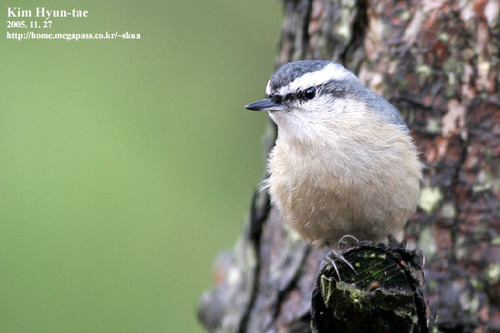


ID tip
This species is locally found in sympatry with the Eurasian nuthatch (S. europaea), but differs from it in its smaller size, clearly visible white supercilium, black crown in males, and relatively plain underparts, lacking the reddish undertail coverts and flanks. In the west of its range, the Chinese nuthatch can also be found with Przevalski's nuthatch (S. przewalskii), and both have brightly cinnamon-coloured underparts. The Chinese nuthatch is easily distinguished by its black eyestripe, while Przevalski's nuthatch has very light cheeks contrasting with the breast. Voice: The Chinese nuthatch sings from the tops of pine and spruce trees. Harrap gives three basic types of calls. The first is a harsh, prolonged schraa, schraa call, reminiscent of the Eurasian jay (Garrulus glandarius), and similar to some calls found in the Corsican nuthatch, Algerian nuthatch, and Krüper's nuthatch. Given, in agitation or excitement, singly or in irregular series at intervals of 0.
Text from Wikipedia, licensed CC BY-SA 4.0.
When to see the Chinese Nuthatch
One bar for each month, and every month is filled: this bird is recorded here in all twelve. The wide bar is May, the month with the most records.
Where to see the Chinese Nuthatch
The map shades 4 countries with regular records. Everything unshaded has no records. Countries are listed below the map.
About the Chinese Nuthatch
The Chinese nuthatch or snowy-browed nuthatch is a species of bird in the family Sittidae. It is a small nuthatch, measuring 11.5 cm (4.5 in) in length. The upperparts are blue-grey and the underparts from a dull buff-greyish to a cinnamon-orange; the cheeks are white. There is a marked sexual dimorphism: the adult male is distinguished by its very black crown, while that of the female is the same blue-grey as the back, or at most dark grey when the plumage is worn. In both sexes, a dark grey eyestripe extends in front of and behind the eye, topped by a clear white supercilium separating it from the crown. The song is variable, and composed of repetitions of small invariant whistles.
Text adapted from Wikipedia, licensed CC BY-SA 4.0.
Easily confused with
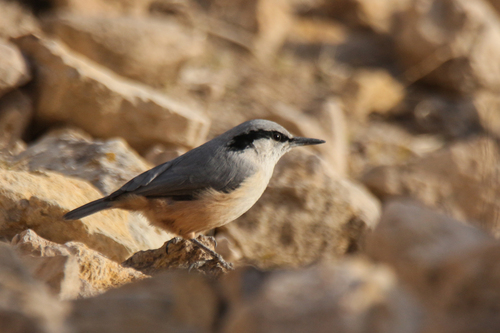 Eastern Rock NuthatchSitta tephronotaEastern rock nuthatch is 15–16 cm long.
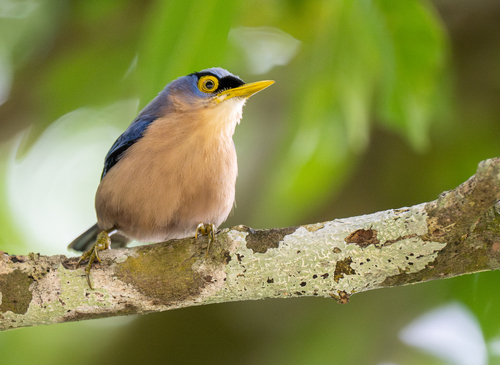 Sulphur-billed NuthatchSitta oenochlamysThe sulphur-billed nuthatch is a species of bird in the family Sittidae.
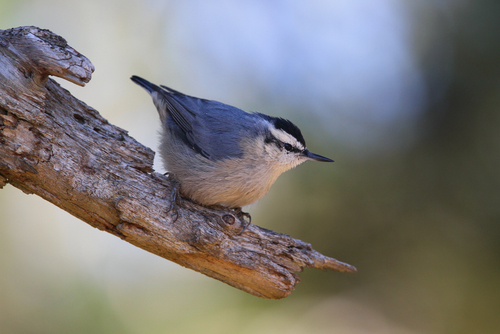 Corsican NuthatchSitta whiteheadiThe Corsican nuthatch is the only nuthatch found in Corsica, however, it may be reminiscent of the coal tit (Periparus ater), which is common in Corsican forests and has similar markings on its head.
Side by side: Chinese Nuthatch vs Krüper's Nuthatch · Chinese Nuthatch vs Eastern Rock Nuthatch
Learn the Chinese Nuthatch in the BeakBrain App
Photo and call practice. Coming soon to iPhone and Android.
Play today's Daily BirdEvery photo and recording on this page is credited to its author under the licence shown. Spotted a problem with this page, or have a better photo? Contribute.