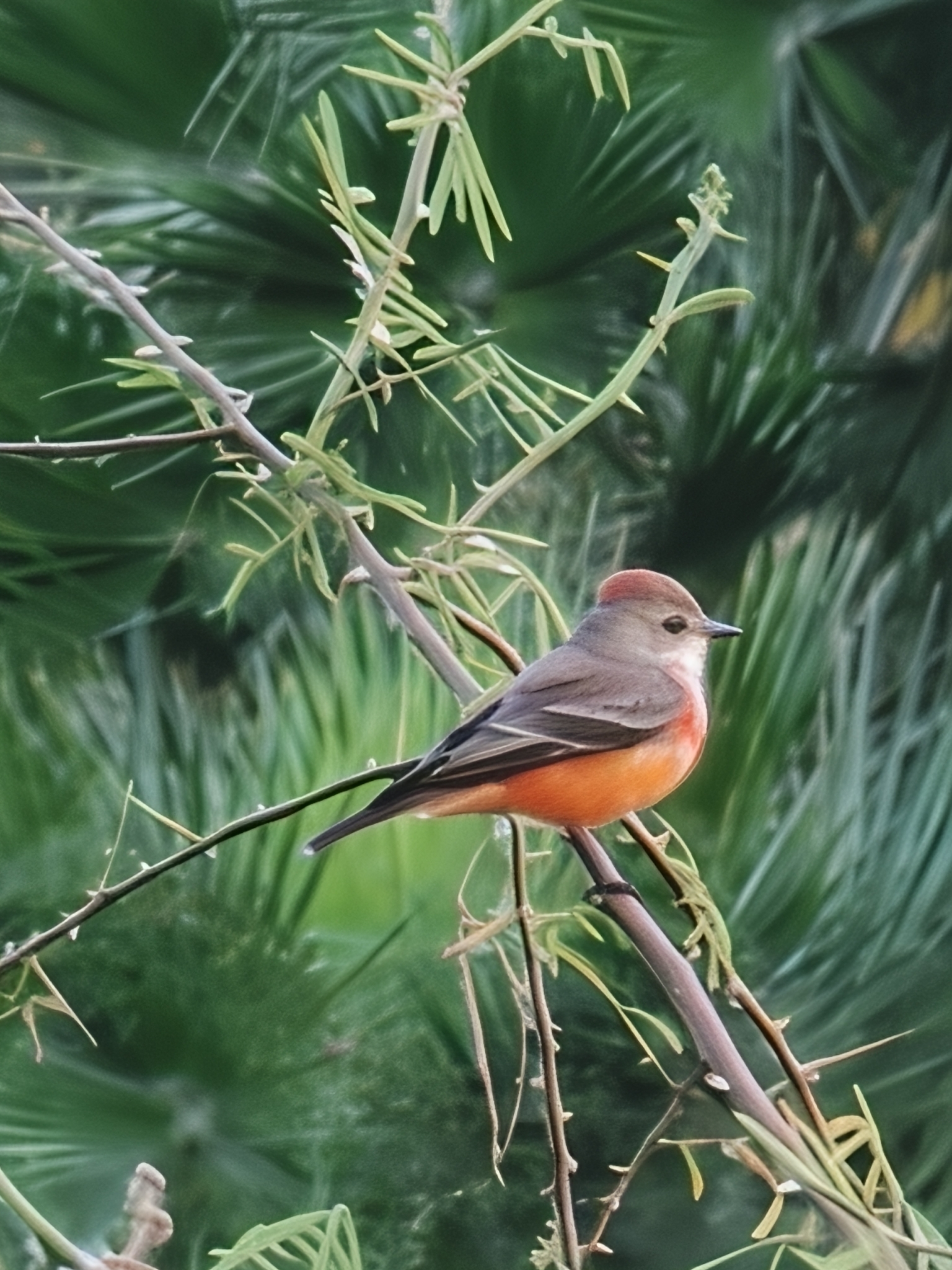
Vermilion Flycatcher
Pyrocephalus rubinus
The scarlet flycatcher is about 14 cm (5.5 in) long. and weighs 12 to 15 g (0.42 to 0.53 oz).Adult males have an intense poppy red forehead and crown down to the eye. Their lores and ear coverts are dark grayish brown and form a "mask". Their nape, upperparts, and tail are blackish and their rump blackish brown. Their wings are blackish with paler edges on the coverts and tertials. The lower part of their face, their throat, and their underparts are a slightly lighter shade of poppy red than the crown, with sometimes an orangey tinge. Voice: The scarlet flycatcher's song is an "extr. high tic-tic-psiieh" whose last part may be upslurred, and its call is an "extr. high psi".
ID text from Wikipedia, CC BY-SA 4.0

Western Flycatcher
Empidonax difficilis
Adults have olive-gray upperparts, darker on the wings and tail, with yellowish underparts; they have a conspicuous teardrop-shaped white eye ring, white wing bars, a small bill and a short tail. It differs only subtly from most Empidonax flycatchers in North America, but its breeding habitat and call are different. Many species of this genus look closely alike. The best ways to distinguish species are by voice, by breeding habitat, and by range.
ID text from Wikipedia, CC BY-SA 4.0
Where you might meet both
Learn this pair in BeakBrain
Photo and call practice, free in any browser.
Play BeakBrainPhotos and recordings are credited to their authors under the licence shown. Full profiles: Vermilion Flycatcher and Western Flycatcher.