
Variable Wheatear
Oenanthe picata
The variable wheatear is a bird of arid and semi-arid region, and is locally abundant in barren rocky areas, sand dunes with scrub vegetation, cultivation, ravines, outside villages and nomadic encampments. It is polymorphic and has three distinct morphs. Black-bellied phase (opistholeuca). Male (adult). Entirely jet black except rump, under tail-coverts, base and sides of tail which are white; central rectrices and terminal band of tail black. Female has black parts replaced by sooty black. White-bellied phase (picata) Male (adult). Like the preceding but belly white.
ID text from Wikipedia, CC BY-SA 4.0
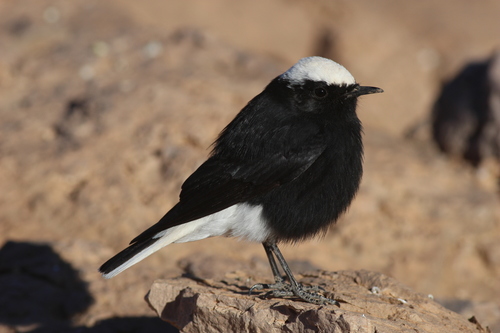
White-crowned Wheatear
Oenanthe leucopyga
This large 17–18 cm long wheatear breeds in stony deserts from the Sahara and Arabia across to Iraq. It is largely resident but has occurred as a rare vagrant to western Europe as far away as Great Britain. It nests in crevices in rocks or walls laying 3-5 eggs. Although most wheatear species have distinctive male and female plumages, adults of both sexes of this species are black except for a white rump and mainly white tail. Full adults have a white crown, not shown by young birds.
ID text from Wikipedia, CC BY-SA 4.0
Where you might meet both
Learn this pair in the BeakBrain App
Photo and call practice. Coming soon to iPhone and Android.
Play today's Daily BirdPhotos and recordings are credited to their authors under the licence shown. Full profiles: Variable Wheatear and White-crowned Wheatear.