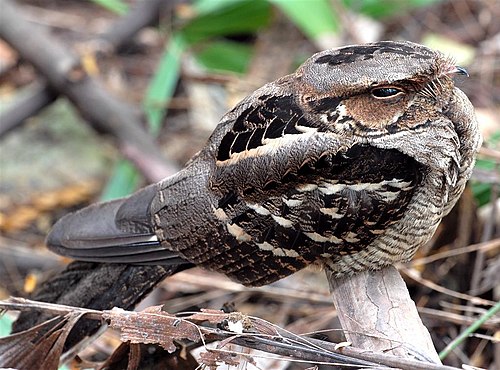
Large-tailed Nightjar
Caprimulgus macrurus
The large-tailed nightjar measures approximately 31.5 to 33 cm in length. The cryptic plumage and colouration of large-tailed nightjars provide effective camouflage within its natural habitat. Males exhibit distinctive markings, characterized by a pale crown with a dark median stripe. A prominent row of black scapular feathers, bordered by broad buff or whitish-buff fringes, enhances their striking appearance. Additionally, males possess a white throat patch and along, broad brown tail marked with uneven dark bars. Voice: Songs can be heard year-round, but vocal activity may vary depending on breeding activity, population density, and moon phase. The large-tailed nightjar has a distinctive, monotonous song that it uses to assert its territory. Territorial songs are typically given by males, but there are also reports of females giving these songs.
ID text from Wikipedia, CC BY-SA 4.0

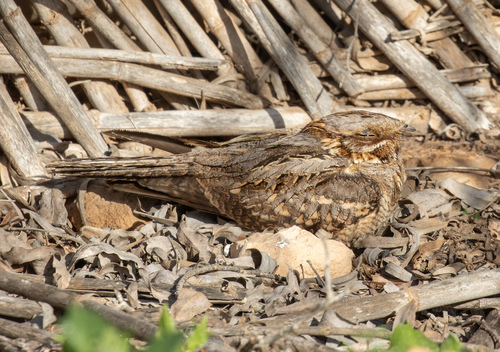
Red-necked Nightjar
Caprimulgus ruficollis
The variegated plumage resembles the European nightjar. The adult is lichen-grey, barred and streaked with buff, chestnut and black. The underparts are barred. It is larger and longer-tailed than the more widespread species, and has a rufous neck-collar. Both sexes have white wing spots, tail sides and throat. During the day this nightjar lies silent upon the ground, concealed by its plumage; it is difficult to detect, looking like a bit of lichen-covered twig or a fragment of bark. The length is 32 cm, and the wingspan 64 cm. Voice: Its call is a repetitive mechanical kyok-kyok-kyok..., which rises and falls as the bird turns its head from side to side. When it churrs, the bird lies or crouches along a branch or rail, but it will sing from a post. During courtship, and occasionally at other times, it uses a mechanical signal, a sharp cracking sound, caused by clapping the wings together over the back.
ID text from Wikipedia, CC BY-SA 4.0

Learn this pair in the BeakBrain App
Photo and call practice. Coming soon to iPhone and Android.
Play today's Daily BirdPhotos and recordings are credited to their authors under the licence shown. Full profiles: Large-tailed Nightjar and Red-necked Nightjar.