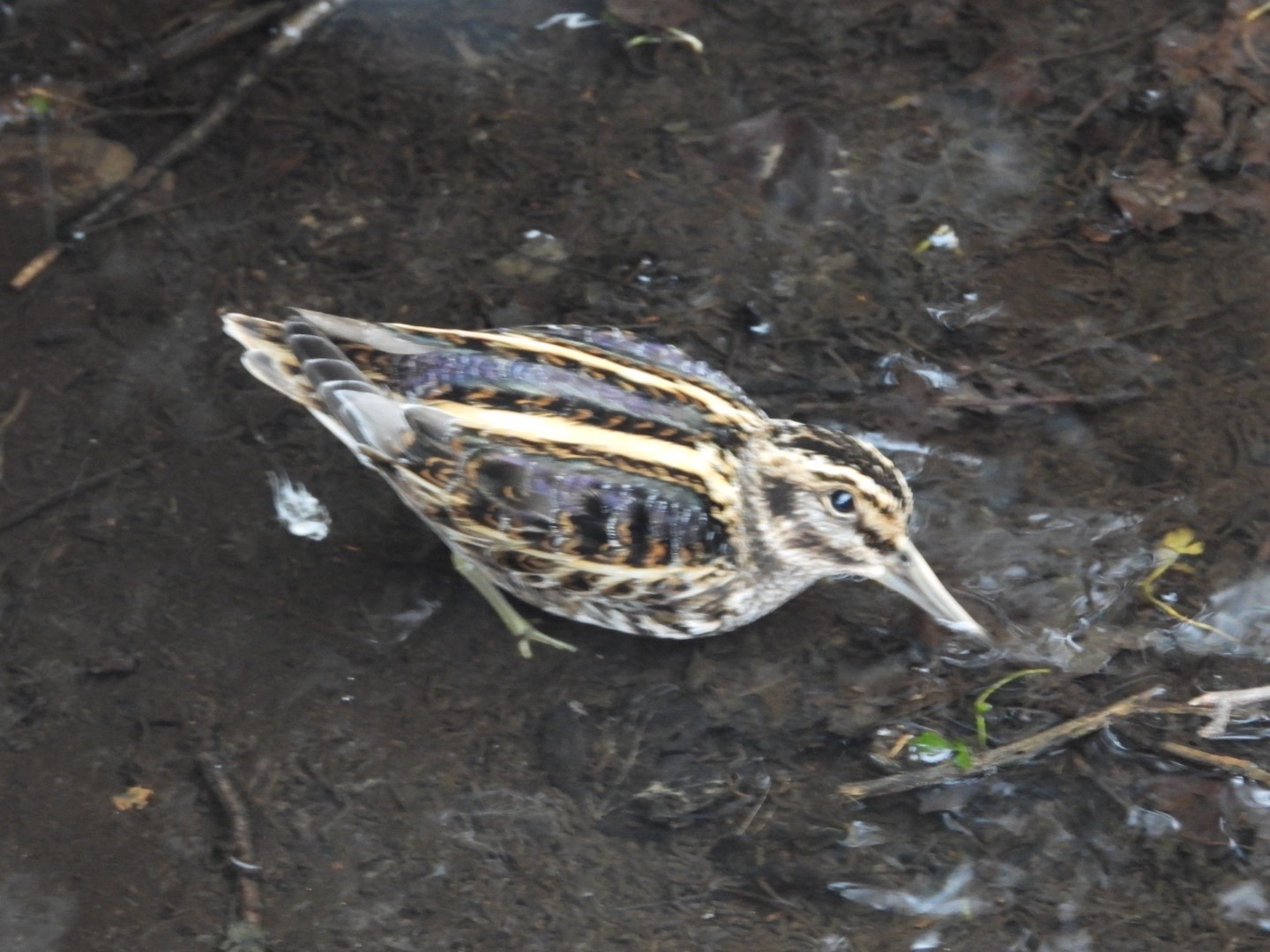
Jack Snipe
Lymnocryptes minimus
Adults are smaller than common snipes and have relatively shorter bills. The bird's length is 18–25 cm (7.1–9.8 in), wingspan is 30–41 cm (12–16 in) and weight is 33–73 g (1.2–2.6 oz). The body is mottled brown on top and pale underneath. Jack snipes have a dark stripe through the eye. The wings are pointed and narrow, and yellow back stripes are visible in flight. When seen, the distinctive bobbing movement, as if the bird is on springs, has an almost hypnotic quality.
ID text from Wikipedia, CC BY-SA 4.0


Sharp-tailed Sandpiper
Calidris acuminata
A small-medium wader, the portly sandpiper has a pot belly, flat back and somewhat drawn-out rear end. It has a mottled chestnut-brown upper body with sharp-looking feathers with a dark centre, a chestnut cap on its head and a brown stripe through each eye. Its bill is dark grey to black and straight, and its legs are olive- to yellow-coloured. The underparts are white or paler in colour, with the mottling similar to that on the breast and sides of the belly. The plumage is more vivid during the breeding season and duller in its winter plumage.
ID text from Wikipedia, CC BY-SA 4.0
Where you might meet both
Learn this pair in the BeakBrain App
Photo and call practice. Coming soon to iPhone and Android.
Play today's Daily BirdPhotos and recordings are credited to their authors under the licence shown. Full profiles: Jack Snipe and Sharp-tailed Sandpiper.