
Ivory Gull
Pagophila eburnea
The ivory gull is 40–43 cm (16–17 in) long, with a wingspan of 108–120 cm (43–47 in); males weigh between 500–687 g (17.6–24.2 oz) and females between 448–583 g (15.8–20.6 oz). This species is easy to identify. It has a different, more pigeon-like shape compared to the Larus gulls, an impression reinforced by its short legs. The adult has completely pure white plumage, lacking the grey back of other gulls. The thick bill is blue with a yellow tip (occasionally with a reddish tip), and the legs are black. The eyes are dark, with a narrow dark red orbital ring.
ID text from Wikipedia, CC BY-SA 4.0
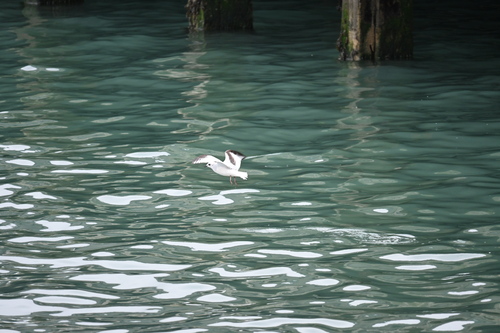
Ross's Gull
Rhodostethia rosea
This small bird is similar in size and some plumage characteristics to the little gull. It is slightly larger and longer winged than the little gull, and has more pointed wings and a wedge-shaped tail. Its legs are red. Summer adults are pale grey above and white below, with a pink flush to the body feathering, and a neat black neck ring. In winter, the neck collar is lost, and a small dark crescent develops behind the eye; the pink colour, which is diet-related, is lost in some but not all individuals.
ID text from Wikipedia, CC BY-SA 4.0
Where you might meet both
Learn this pair in the BeakBrain App
Photo and call practice. Coming soon to iPhone and Android.
Play today's Daily BirdPhotos and recordings are credited to their authors under the licence shown. Full profiles: Ivory Gull and Ross's Gull.