
Greyish Baywing
Agelaioides badius
The greyish baywing is 19 cm (7 in) long. Males weigh an average of about 46 g (1.6 oz) and females average about 42 g (1.5 oz). Both sexes of both subspecies have the same plumage though A. b. bolivianus is larger than the nominate A. b. badius. Adults have a mostly grayish buffy brown head, neck, and upperparts. They have blackish lores and ear coverts and an otherwise grayish buffy brown face. Their uppertail coverts are olive-brown and their tail very dark olive-brown. Voice: The greyish baywing sings "a quiet, musical continuum of warbles and trills, often in chorus". In flight both sexes give a "clear prolonged whistle peeeooh". Its primary call has been written as a "harsh, hoarse, guttural chuck", " a squeaky chayt, chap", a "weak kik errt, kik, riiie, kik krrr, krrr and tji drrrrrrt", and "a sharp clear tuit".
ID text from Wikipedia, CC BY-SA 4.0
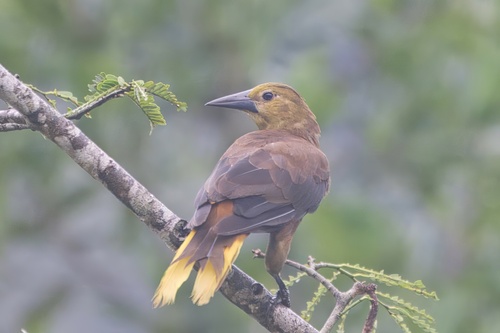
Russet-backed Oropendola
Psarocolius angustifrons
Russet-backed oropendola males are 44 to 48 cm (17 to 19 in) long and females 34 to 38 cm (13 to 15 in). Males weigh about 250 to 470 g (8.8 to 17 oz) and females about 170 to 230 g (6.0 to 8.1 oz). Adult males have long feathers on their nape that form a crest and females do not; their plumage is otherwise the same. Adult males of the nominate subspecies P. a. angustifrons have an olivaceous-brown head and a mostly brown body and wings with a russet tinge. Their rump and uppertail coverts are paler russet-brown.
ID text from Wikipedia, CC BY-SA 4.0
Where you might meet both
Learn this pair in BeakBrain
Photo and call practice, free in any browser.
Play BeakBrainPhotos and recordings are credited to their authors under the licence shown. Full profiles: Greyish Baywing and Russet-backed Oropendola.