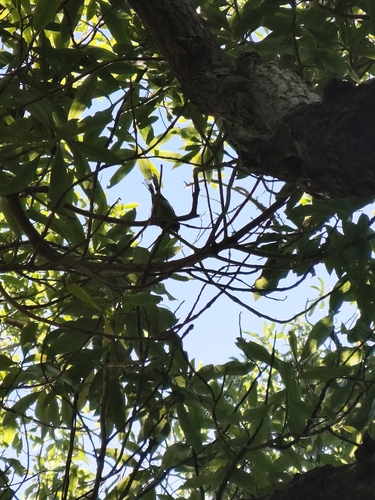
Grey Gerygone
Gerygone igata
The grey warbler has a long tail that is darker than its grey-brown body, with white tail end markings as well as a white tail underside. There is little sexual dimorphism between males and females, aside from females usually being smaller than males. Warblers are especially small; weighing around 6.5g with an average length of only around 10cm. Adults have a signature ruby red eye, while juveniles have a brown eye, as well as yellowish feathers around the face and underbody. Voice: The male's song often starts with a series of three squeaks and builds into a distinctive long plaintive wavering trill that rises and falls. Only the male warblers sing year-round, to attract mates and defend territory. Male songs are particularly loud during summer and spring, which lines up with the warblers breeding season.
ID text from Wikipedia, CC BY-SA 4.0


Western Gerygone
Gerygone fusca
The western gerygone has plain, brownish-grey upperparts, with no prominent wing markings. The underparts are whitish, with variable amounts of grey on the throat and breast. The outer tail-feathers are conspicuously marked, with large, white patches at the base, a broad, blackish, subterminal tail band and white tips. It is usually found singly or in pairs, in the mid to upper storey of trees and shrubs and is often located by its characteristic, persistent song. It can be very active when foraging. Voice: The western gerygone's song is an irregular series of clear, high-pitched whistles, with a meandering melody. Each note maintains a consistent pitch and there is a distinct change in pitch between notes. Although the song isn't loud in volume, its persistence and distinctive tonal qualities are often recognizable from long distances.
ID text from Wikipedia, CC BY-SA 4.0
Learn this pair in the BeakBrain App
Photo and call practice. Coming soon to iPhone and Android.
Play today's Daily BirdPhotos and recordings are credited to their authors under the licence shown. Full profiles: Grey Gerygone and Western Gerygone.