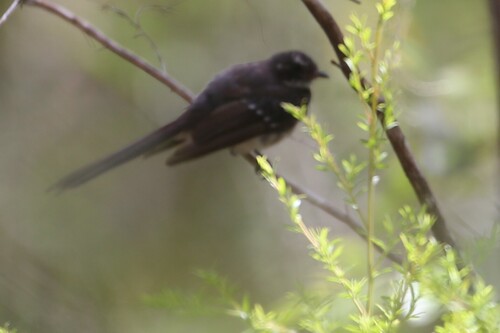
Grey Fantail
Rhipidura albiscapa
This species is mid-to-dark grey or grey-brown above, lighter (often yellowish/orange) below, with a white throat, white markings over the eye, and with (depending on the race) either white-edged or entirely white outer tail feathers. It grows to 16 cm (6.3 in) in length, of which half is the tail, which, as the name implies, is often displayed fanned out. This reveals that the outer tail feathers are light and the centre ones are dark. Some races, such as keasti, have a darker plumage.
ID text from Wikipedia, CC BY-SA 4.0
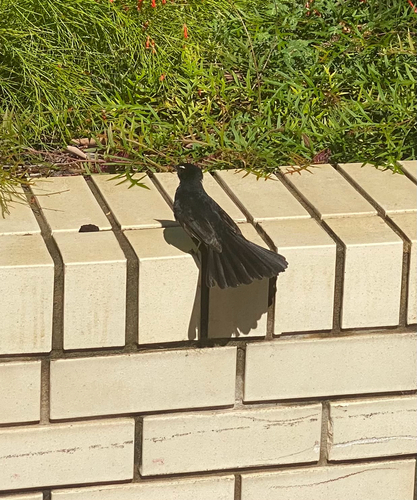
Willie Wagtail
Rhipidura leucophrys
An adult willie wagtail is between 19 and 21.5 cm (7.5 and 8.5 in) in length and weighs 17–24 g (0.6–0.85 oz), with a tail 10–11 cm (approx 4 in) long. The short, slender bill measures 1.64–1.93 cm (around 0.75 in), and is tipped with a small hook. This species has longer legs than other fantails, which may be an adaptation to foraging on the ground. The male and female have similar plumage; the head, throat, upper breast, wings, upperparts, and tail are all black, with a white eyebrow, "whiskers" and underparts. The bill and legs are black and the iris dark brown. Voice: The wagtail is very "chatty" and has a number of distinct vocalisations. Its most-recognised sound is its alarm call which is a rapid chit-chit-chit-chit, although it has more melodious sounds in its repertoire. The alarm call is sounded to warn off potential rivals and threats from its territory and also seems to serve as a signal to its mate when a potential threat is in the area.
ID text from Wikipedia, CC BY-SA 4.0

Where you might meet both
Learn this pair in the BeakBrain App
Photo and call practice. Coming soon to iPhone and Android.
Play today's Daily BirdPhotos and recordings are credited to their authors under the licence shown. Full profiles: Grey Fantail and Willie Wagtail.