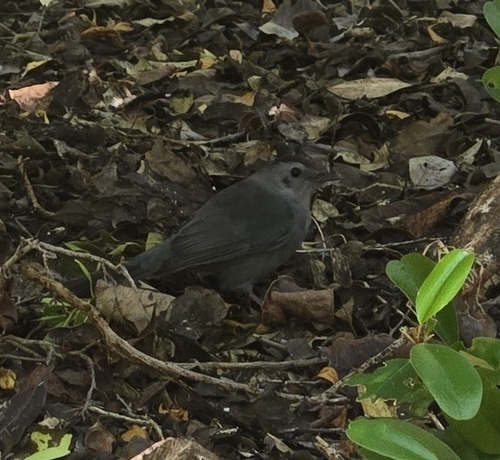
Grey Catbird
Dumetella carolinensis
Adults weigh from 23.2 to 56.5 g (0.8 to 2.0 oz), with an average of 35–40 g (1.2–1.4 oz) They range in length from 20.5 to 24 cm (8.1 to 9.4 in) and span 22 to 30 cm (8.7 to 11.8 in) across the wings. Among standard measurements, the wing chord is 8.4 to 9.8 cm (3.3 to 3.9 in), the tail is 7.2 to 10.3 cm (2.8 to 4.1 in), the culmen is 1.5 to 1.8 cm (0.6 to 0.7 in) and the tarsus is 2.7 to 2.9 cm (1.1 to 1.1 in). Gray catbirds are plain lead gray almost all over. The top of the head is darker. Voice: This species is named for its cat-like call. Like many members of the Mimidae (in particular mockingbirds), it also mimics the songs of other birds, as well as those of Hylidae (tree frogs), and even mechanical sounds. Because of its well-developed songbird syrinx, it is able to make two sounds at the same time. The alarm call resembles the quiet calls of a male mallard.
ID text from Wikipedia, CC BY-SA 4.0

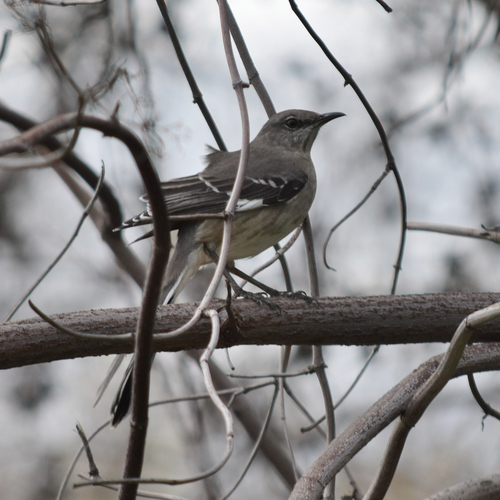
Northern Mockingbird
Mimus polyglottos
The northern mockingbird is a medium-sized mimid that has long legs and tail. Males and females look alike. Its upper parts are colored gray, while its underparts have a white or whitish-gray color. It has parallel wing bars on the half of the wings connected near the white patch giving it a distinctive appearance in flight. The black central rectrices and typical white lateral rectrices are also noticeable in flight. The iris is usually a light green-yellow or a yellow, but there have been instances of an orange color. The bill is black with a brownish black appearance at the base. Voice: Although many species of bird imitate the vocalizations of other birds, the northern mockingbird is the species best known in North America for doing so.
ID text from Wikipedia, CC BY-SA 4.0

Where you might meet both
Learn this pair in the BeakBrain App
Photo and call practice. Coming soon to iPhone and Android.
Play today's Daily BirdPhotos and recordings are credited to their authors under the licence shown. Full profiles: Grey Catbird and Northern Mockingbird.