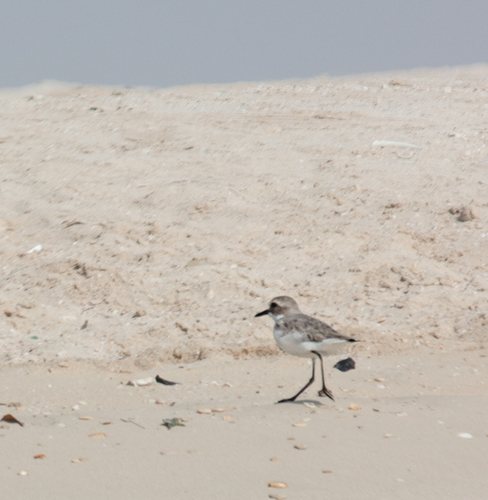
Greater Sand Plover
Anarhynchus leschenaultii
This chunky plover is 19–22 cm long, slightly larger than a common ringed plover, and is conspicuously long-legged and thick-billed. Breeding males have sandy buff backs and white underparts. The breast, forehead and nape are variably orange in summer, and there is a black eye mask in summer. The female is duller and greyer, and winter and juvenile birds are browner, apart from a hint of rufous on the head. The legs are greenish-yellow and the bill black. In all plumages, it is very similar to its close relatives Siberian sand plover A. mongolus and Tibetan sand plover A. atrifrons.
ID text from Wikipedia, CC BY-SA 4.0

Kentish Plover
Anarhynchus alexandrinus
The Kentish plover is a small shorebird weighing around 40 g as an adult. Both male and female birds have black bills and dark legs, however adults have dimorphic plumage. During the breeding season, males have a black horizontal head bar, two incomplete dark breast-bands on each side of their breast, black ear coverts and a rufous nape and crown (although there is some variation between breeding populations), whereas the females are paler in these areas, without the dark markings. Voice: The alarm call, referred to as kittup call, is often heard both on the ground and in the air and can occur on its own, or paired with a tweet, heard as too-eet. The threat note is described as a "twanging, metallic, dwee-dwee-dweedweedwee sound".
ID text from Wikipedia, CC BY-SA 4.0
Where you might meet both
And 40 more countries.
Learn this pair in the BeakBrain App
Photo and call practice. Coming soon to iPhone and Android.
Play today's Daily BirdPhotos and recordings are credited to their authors under the licence shown. Full profiles: Greater Sand Plover and Kentish Plover.