
Egyptian Goose
Alopochen aegyptiaca
It swims well and appears heavy in flight, more like a goose than a duck, hence the English name. On average, they are 63–73 cm (25–29 in) in length and weigh 1,500–2,348 g (3.307–5.176 lb) The sexes of this species are identical in plumage but the males are usually somewhat larger. They vary greatly in plumage tone, with some birds greyer and others browner, but this variation has not been observed to be sex- or age-related. A large part of the wings of mature birds is white, but the white is hidden by the wing coverts when at rest.
ID text from Wikipedia, CC BY-SA 4.0

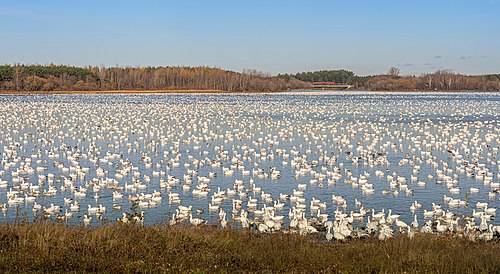
Snow Goose
Anser caerulescens
The snow goose has two color plumage morphs, white (snow) or gray/blue (blue), thus the common description as "snows" and "blues". White-morph birds are white except for black wing tips, but blue-morph geese have bluish-gray plumage replacing the white except on the head, neck, and tail tip. The immature blue phase is drab or slate-gray with little to no white on the head, neck, or belly. Both snow and blue phases have rose-red feet and legs and pink bills with black tomia ("cutting edges"), giving them a black "grin patch". These colors distinguish the species from white domesticated geese.
ID text from Wikipedia, CC BY-SA 4.0
Where you might meet both
Learn this pair in the BeakBrain App
Photo and call practice. Coming soon to iPhone and Android.
Play today's Daily BirdPhotos and recordings are credited to their authors under the licence shown. Full profiles: Egyptian Goose and Snow Goose.