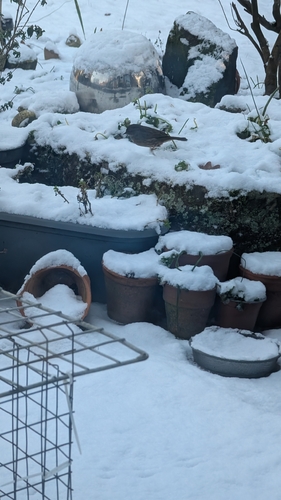
Dunnock
Prunella modularis
A robin-sized bird, the dunnock typically measures 13–14.5 cm (5.1–5.7 in) in length. It has a brown back streaked blackish, somewhat resembling a small house sparrow. Like that species, the dunnock has a drab appearance which may have evolved as camouflage to avoid predation. It is brownish underneath, and has a fine pointed bill. Adults have a dull grey head, and both sexes are similarly coloured; juveniles are browner on the head, looser, 'fluffy' feathering, and more obviously streaked overall.
ID text from Wikipedia, CC BY-SA 4.0


Siberian Accentor
Prunella montanella
The Siberian accentor is on average 14.5 centimetres (5.7 in) long and weighs 17.5 grams (0.62 oz). The adult of the nominate race has brown upperparts and wings, with bright chestnut streaking on its back and a greyish-brown rump and tail. There are two narrow whitish bars on the folded wings. The head has a dark brown crown, a long, wide pale yellow supercilium, a blackish patch behind the eye and grey sides to the neck. The underparts are ochre yellow, becoming strongly buff on the flanks and greyish on the lower belly. Voice: The call of the Siberian accentor is a trisyllabic ti-ti-ti. The male's song, given from the top of a bush or tree, is a loud, high chirichiriri, variously described as similar to that of the Japanese accentor, the dunnock or the black-throated accentor. Breeding birds sing most vigorously early in the season, particularly at dawn, and some individuals may also sing on migration.
ID text from Wikipedia, CC BY-SA 4.0
Where you might meet both
Learn this pair in the BeakBrain App
Photo and call practice. Coming soon to iPhone and Android.
Play today's Daily BirdPhotos and recordings are credited to their authors under the licence shown. Full profiles: Dunnock and Siberian Accentor.