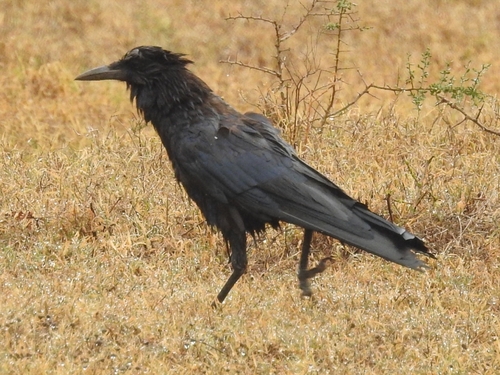
Cape Crow
Corvus capensis
Voice: The voice is described as a krrah.....krrah.....krrah or a quicker kah-kah-kah. It also makes very loud, liquid bubbling sounds that carry quite a distance; it also gives throaty chuckles. Some evidence indicates that vocal mimicry is practised, too.
ID text from Wikipedia, CC BY-SA 4.0
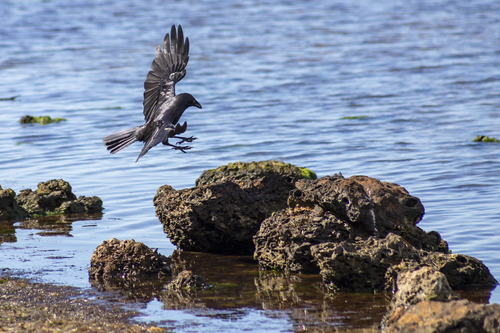
Forest Raven
Corvus tasmanicus
The largest of the Australian corvids, the adult forest raven is 50–53 cm (20–21 in) long with a wingspan of 91–113 cm (36–44 in) and weighing approximately 650 g (1.43 lb). There is no seasonal variation in plumage, which is entirely glossy black with a blue or green sheen visible on the upperparts. The wings are long and broad, with the largest of its ten primary feathers (usually the seventh but occasionally the eighth) almost reaching the end of the tail when at rest. The tail is rounded or wedge-shaped. It is quite short in Tasmanian populations but longer in northern New South Wales. Voice: The call is considered the most reliable means of identification in areas where the forest raven's range overlaps with other corvids. It is a deep and husky "korr-korr-korr-korr" with a similarly drawn out last note to the Australian raven. It can also utter a barking alarm call. The calls of juveniles have a higher pitch than those of adult birds.
ID text from Wikipedia, CC BY-SA 4.0
Learn this pair in the BeakBrain App
Photo and call practice. Coming soon to iPhone and Android.
Play today's Daily BirdPhotos and recordings are credited to their authors under the licence shown. Full profiles: Cape Crow and Forest Raven.