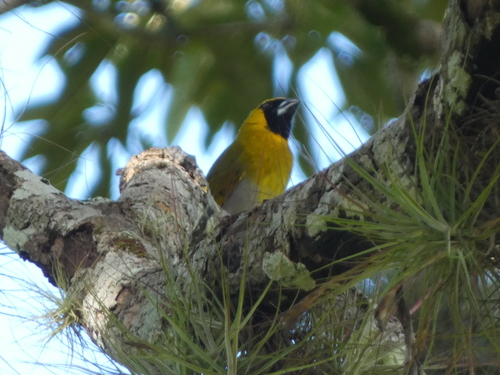
Black-faced Grosbeak
Caryothraustes poliogaster
The adult black-faced grosbeak is 16.5 cm long, weighs 36 g, and has a heavy, mainly black, bill. It has a black face, yellow head, neck and breast, and olive back, wings and tail. The rump and belly are grey. Immatures are duller and have duskier face markings. The vocalisations include sharp chip or tweet calls, buzzes and whistles, and the song is a musical whistled cher chi weet, cher chir weet, cher chi chuweet.
ID text from Wikipedia, CC BY-SA 4.0
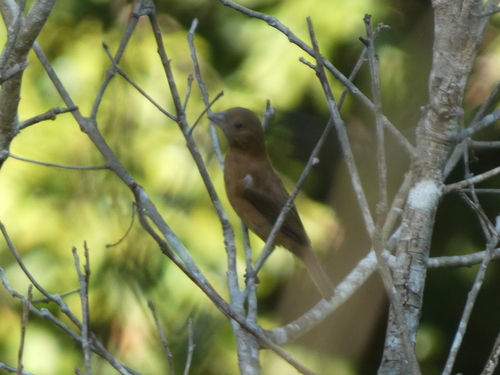
Blue Bunting
Cyanocompsa parellina
The nominate subspecies of blue bunting is 13 to 14 cm (5.1 to 5.5 in) long. Males weigh 11 to 24 g (0.39 to 0.85 oz) and females 9.8 to 21 g (0.35 to 0.74 oz). The nominate male is various shades of blue, sky blue on the forehead and cheek, blackish blue on the upperparts, ultramarine on the rump, and the underparts from chin to belly deep blue. The adult and immature females are overall dull brownish, with a reddish tinge to the belly. The immature male is overall gray-blue with a brownish wash on the belly. Compared to the nominate, the C. p. Voice: The blue bunting's song is "a sweet, rather sad warble" . Its call is a metallic note .
ID text from Wikipedia, CC BY-SA 4.0
Where you might meet both
Learn this pair in the BeakBrain App
Photo and call practice. Coming soon to iPhone and Android.
Play today's Daily BirdPhotos and recordings are credited to their authors under the licence shown. Full profiles: Black-faced Grosbeak and Blue Bunting.