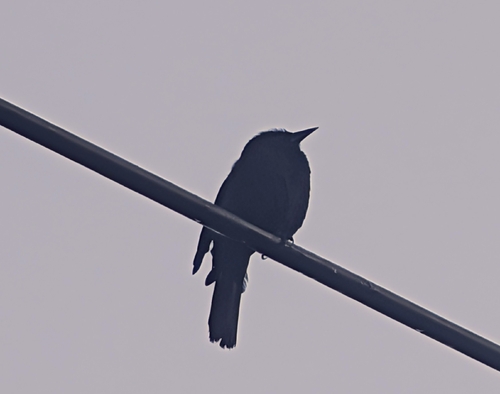
Austral Blackbird
Curaeus curaeus
Its plumage is entirely black with a slight bluish hint, and its physical features consist of black legs, black eyes, and a sharp beak with missing pigmentation in the head, chest, and wings. Compared to other birds in its family, the Austral Blackbird has a highly varied voice, and they do a lot of singing and calling together.
ID text from Wikipedia, CC BY-SA 4.0
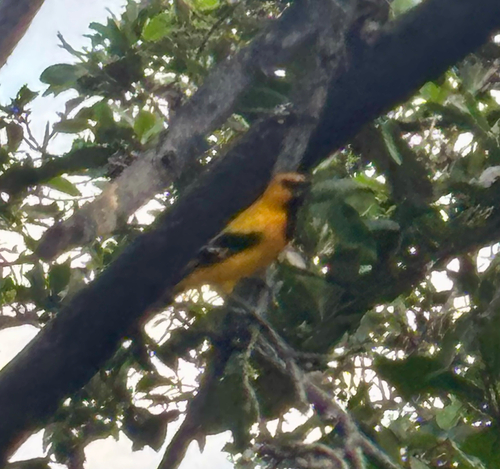
Yellow Oriole
Icterus nigrogularis
The yellow oriole is 20 to 21 cm (7.9 to 8.3 in) long and weighs about 38 g (1.3 oz). Adult males of the nominate subspecies I. n. nigrogularis are mostly bright yellow though somewhat paler on the belly. They have black lores, a black "mask", and a black "bib" from the chin to the upper breast. Their wings are mostly black with white edges on the flight feathers, yellow lesser and median coverts, and white tips on the greater coverts, tertials, and primaries. The last show as a white patch on the folded wing. Their tail is black with small white tips on the outer two pairs of feathers. Voice: The yellow oriole's song is "a detached of short musical phrases, tur-a-leet, tur-sweet, tuur...tweet, tweet and so on". It's dawn song adds "harsh and high-pitched notes". One call is "a rather sharp ka-chek over and over".
ID text from Wikipedia, CC BY-SA 4.0

Learn this pair in the BeakBrain App
Photo and call practice. Coming soon to iPhone and Android.
Play today's Daily BirdPhotos and recordings are credited to their authors under the licence shown. Full profiles: Austral Blackbird and Yellow Oriole.