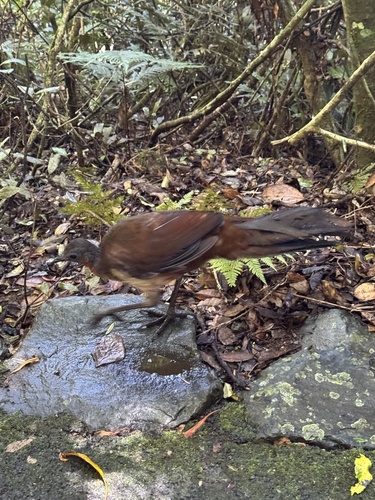
Albert's Lyrebird
Menura alberti
Albert's lyrebird is a ground-dwelling bird. Females reach approximately 75 cm (30 in) in length and males reach about 90 cm (35 in). They have a wingspan of 76–79 cm (30–31 in) and weigh about 930 g (33 oz). They are chestnut-brown in colour with a rufous undertail, rump, and throat. The bill is black; the iris dark brown or black, and it has a broad, blue-grey ring around the eye. The legs and feet are brownish grey to dark grey or black. The sexes are alike except for the shape of the tail. Voice: Both this species and the superb lyrebird have powerful, flexible voices and use a mixture of their own calls and mimicry of other species in long unbroken passages of song. In comparison to the superb lyrebird, the Albert's lyrebird limits its mimicry to a smaller range of species, with the green catbird and satin bowerbird featuring strongly in its imitations, as well as whipbirds and rosellas.
ID text from Wikipedia, CC BY-SA 4.0

Superb Lyrebird
Menura novaehollandiae
The superb lyrebird is a large, pheasant-sized terrestrial passerine, ranging in length from 860 mm (34 in) for the female to 1 m (39 in) for the male. Females weigh around 0.9 kg (2.0 lb), and males weigh around 1.1 kg (2.4 lb). The plumage colour is mainly dark brown on the upper body, with greyish-brown underparts and red-tinged flight feathers, its feathers are brighter tail than that of Albert's lyrebirds. The wings are short and round, and are only capable of weak flight, being mainly used for balance or for gliding from trees to the ground.
ID text from Wikipedia, CC BY-SA 4.0

Where you might meet both
Learn this pair in the BeakBrain App
Photo and call practice. Coming soon to iPhone and Android.
Play today's Daily BirdPhotos and recordings are credited to their authors under the licence shown. Full profiles: Albert's Lyrebird and Superb Lyrebird.