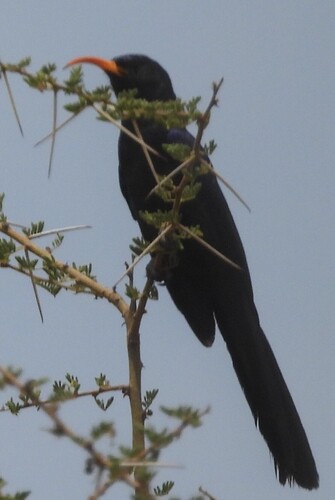
Abyssinian Scimitarbill
Rhinopomastus minor
The bird is all black with a blue-purple iridescence which covers their whole body and especially the back of the head. The bird's beak is bright orange to red and is characteristically curved and pointed. It is slightly longer than the length of its head and is built to probe into cracks and crevices for insects. It can be differentiated from other wood hoopoes by its all black legs and shorter tail, which is about the length of the bird's body excluding its head. Voice: The Abyssian Scimitarbill and the Common Scimitarbill (Rhinopomastus cyanomelas) both emit sharp cries and an unpleasant odor to deter predators (Hedley & Caro, 2022). Their warning calls sound like a series of rising notes "dok". Other calls sound like shrill elongated chirps which rise and then fall minutely in pitch over the course of around eight to twelve chirps.
ID text from Wikipedia, CC BY-SA 4.0
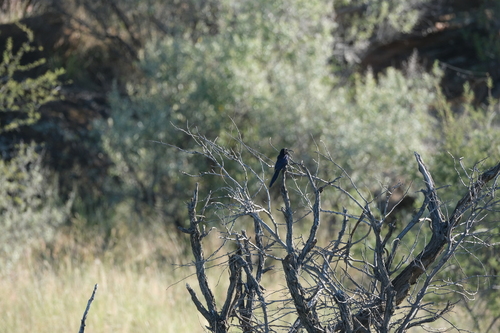
Common Scimitarbill
Rhinopomastus cyanomelas
Adults weigh roughly 35 grams and 26 cm in length. As adults, their beaks are black but as juveniles, their beaks are grey. Females and juveniles are more brown on the front of their body. They feed almost entirely on insects behind the bark of a tree, which is the reason for their probing beak.
ID text from Wikipedia, CC BY-SA 4.0
Where you might meet both
Learn this pair in the BeakBrain App
Photo and call practice. Coming soon to iPhone and Android.
Play today's Daily BirdPhotos and recordings are credited to their authors under the licence shown. Full profiles: Abyssinian Scimitarbill and Common Scimitarbill.