Learn what every symbol on the card means.Full credits and sources at beakbrain.com/symbols
 GrasslandDomed nestTiny · 8 g


What the Common Waxbill sounds like


ID tip
It is a small bird, 9.5–13 centimetres (3.7–5.1 in) long and weighing 6–11 g (0.21–0.39 oz). It has a slender body with short rounded wings and a long graduated tail. The bright red bill of the adult is the colour of sealing wax giving the bird its name. The plumage is mostly grey-brown, finely barred with dark brown. There is a red stripe through the eye and the cheeks and throat are whitish. There is often a pinkish flush to the underparts and a reddish stripe along the centre of the belly depending on the subspecies. The rump is brown and the tail and vent are dark.
Text from Wikipedia, licensed CC BY-SA 4.0.
When to see the Common Waxbill
One bar for each month, and every month is filled: this bird is recorded here in all twelve. The wide bar is October, the month with the most records.
Where to see the Common Waxbill
The map shades 51 countries with regular records, and 8 more in a lighter tone where the bird turns up only as a stray. Everything unshaded has no records. Countries are listed below the map.
Recorded as a rare visitor in France, Israel, Belgium, United Kingdom, Côte d’Ivoire, Argentina, Bahrain, Italy.
About the Common Waxbill
The common waxbill, also known as the St Helena waxbill, is a small passerine bird belonging to the estrildid finch family. It is native to sub-Saharan Africa but has been introduced to many other regions of the world and now has an estimated global extent of occurrence of 10,000,000 km2. It is popular and easy to keep in captivity.
Text adapted from Wikipedia, licensed CC BY-SA 4.0.
Easily confused with
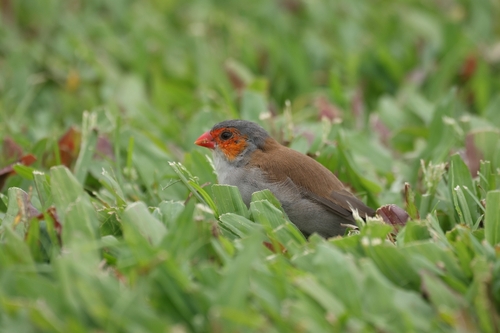 Orange-cheeked WaxbillEstrilda melpodaThe orange-cheeked waxbill is a common species of estrildid finch native to western and central Africa, with an estimated global extent of occurrence of 3,600,000 km2.
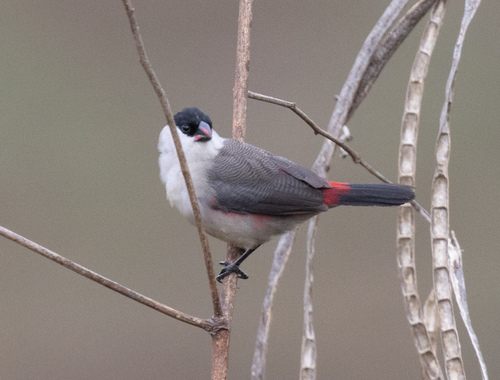 Black-crowned WaxbillEstrilda nonnulaThe black-crowned waxbill is a common species of estrildid finch found in western-central Africa.
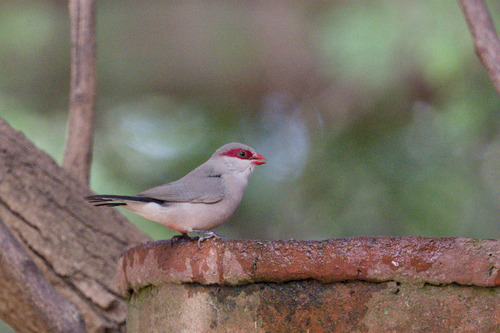 Black-rumped WaxbillEstrilda troglodytesThe black-rumped waxbill is a common species of estrildid finch found in Southern Africa.
Learn the Common Waxbill in the BeakBrain App
Photo and call practice. Coming soon to iPhone and Android.
Play today's Daily BirdEvery photo and recording on this page is credited to its author under the licence shown. Spotted a problem with this page, or have a better photo? Contribute.