Learn what every symbol on the card means.Full credits and sources at beakbrain.com/symbols
 ForestPlatform nestMedium · 102 g


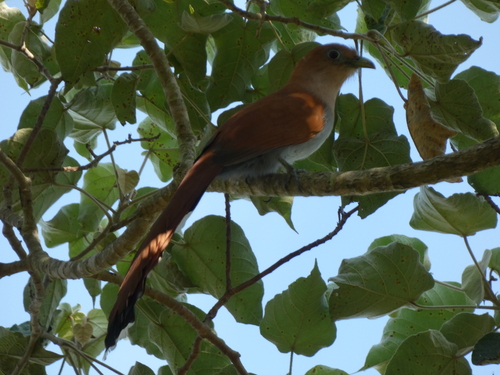
ID tip
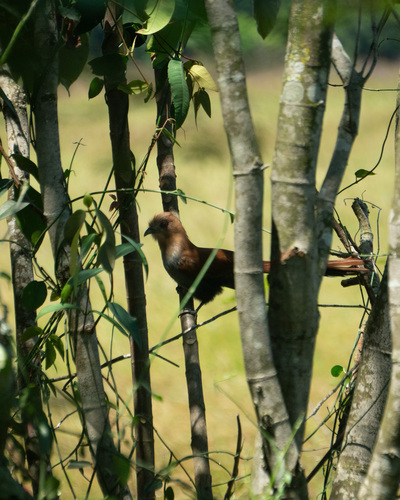
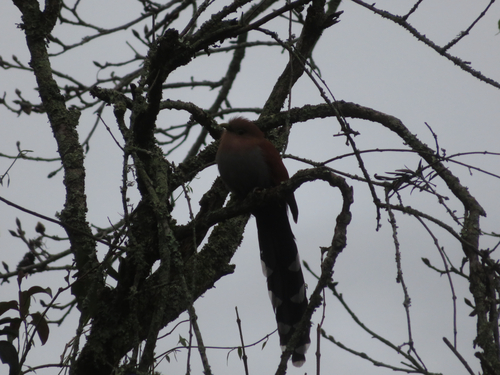
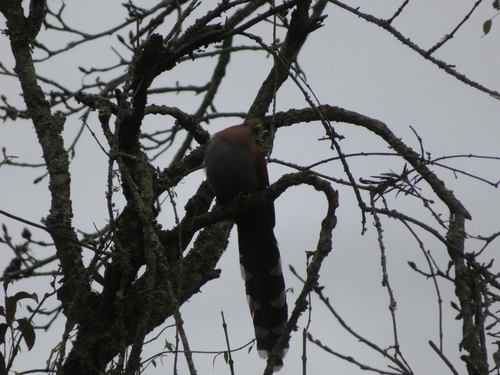
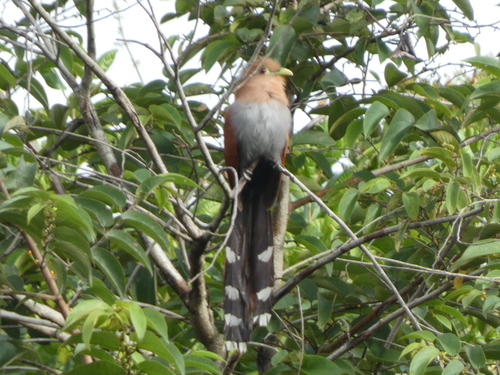
This large and extremely long-tailed cuckoo is 40.5–50 cm (15.9–19.7 in) long and weighs 95–120 g (3.4–4.2 oz). The adult has mainly chestnut upperparts and head, becoming paler on the throat. The lower breast is grey and the belly is blackish. The central tail feathers are rufous, but the outer are black with white tips. The bill is yellow and the iris is red. Immature birds have a grey bill and eyering, brown iris, and less white in the tail. It resembles the little cuckoo, but that species is smaller and has a darker throat. There are a number of subspecies with minor plumage variations.
Text from Wikipedia, licensed CC BY-SA 4.0.
When to see the Common Squirrel Cuckoo
One bar for each month, and every month is filled: this bird is recorded here in all twelve. The wide bar is October, the month with the most records.
Where to see the Common Squirrel Cuckoo
The map shades 21 countries with regular records. Everything unshaded has no records. Countries are listed below the map.
About the Common Squirrel Cuckoo
The common squirrel cuckoo is a large and active species of cuckoo found in wooded habitats from northwestern Mexico to northern Argentina and Uruguay, and on Trinidad. The species was formerly considered to be conspecific with the Mexican squirrel cuckoo.
Text adapted from Wikipedia, licensed CC BY-SA 4.0.
Easily confused with
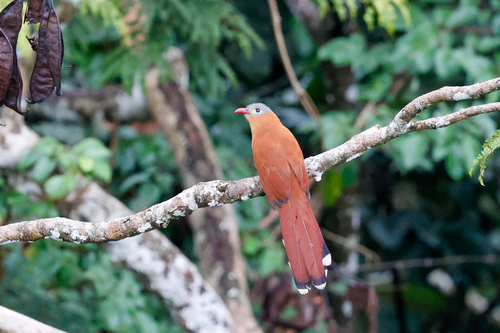 Black-bellied CuckooPiaya melanogasterThe average length of adults is between 38 and 40.5 cm.
 Mexican Squirrel CuckooPiaya mexicanaThis large and extremely long-tailed cuckoo is 45.6 cm (18.0 in) long and weighs 103–108 g (3.6–3.8 oz).
Side by side: Black-bellied Cuckoo vs Common Squirrel Cuckoo
Learn the Common Squirrel Cuckoo in the BeakBrain App
Photo and call practice. Coming soon to iPhone and Android.
Play today's Daily BirdEvery photo and recording on this page is credited to its author under the licence shown. Spotted a problem with this page, or have a better photo? Contribute.