Learn what every symbol on the card means.Full credits and sources at beakbrain.com/symbols
 RockyCavity nestSmall · 50 g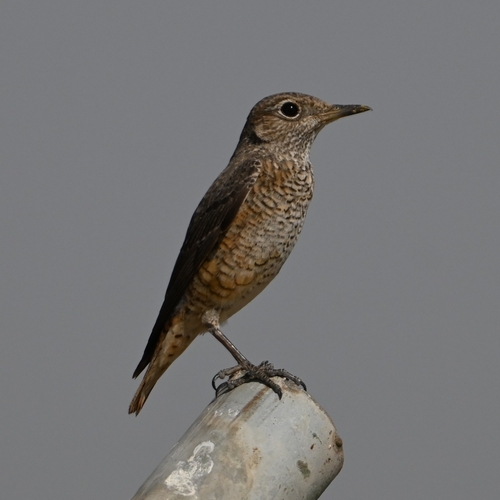
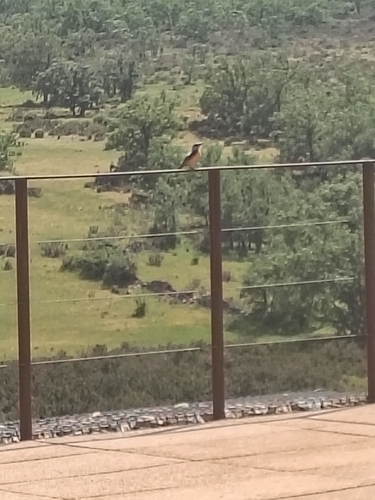
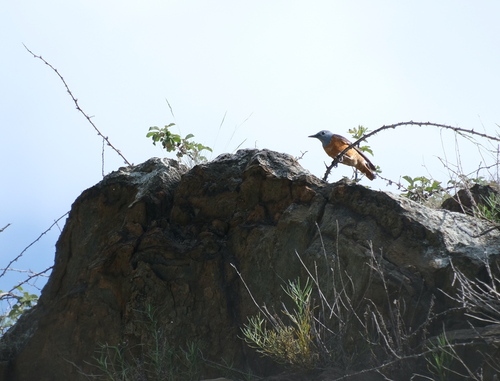


What the Common Rock Thrush sounds like

ID tip
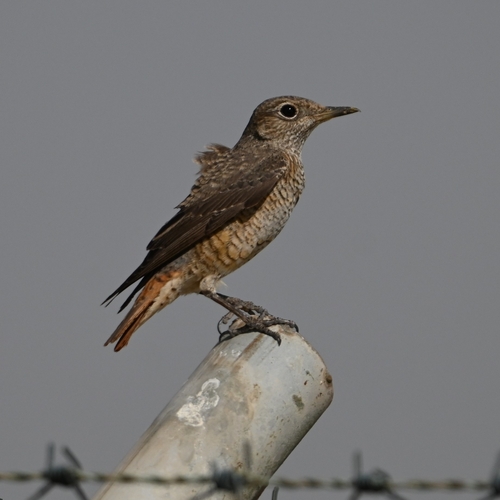
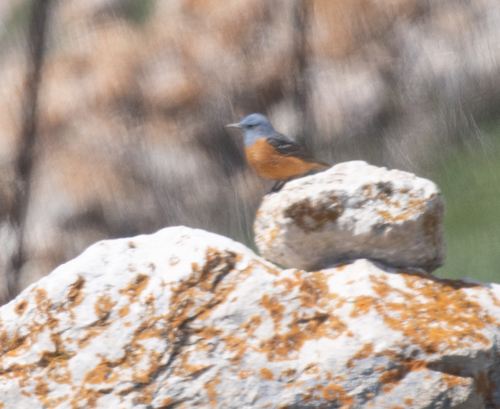
This is a medium-sized but stocky thrush 17–20 cm in length. The summer male is unmistakable, with a blue-grey head, orange underparts and outer tail feathers, dark brown wings and white back. Females and immatures are much less striking, with dark brown scaly upperparts, and paler brown scaly underparts. The outer tail feathers are reddish, like the male.
Text from Wikipedia, licensed CC BY-SA 4.0.
When to see the Common Rock Thrush
One bar for each month. Filled bars are the 7 months with records; pale bars are months with none. The wide bar is May, the month with the most records.
Where to see the Common Rock Thrush
The map shades 69 countries with regular records, and 16 more in a lighter tone where the bird turns up only as a stray. Everything unshaded has no records. Countries are listed below the map.
Recorded as a rare visitor in United Kingdom, Sweden, India, Germany, United States, Netherlands, Poland, Finland, Czechia, Norway, Cameroon, Chad, Guinea, Moldova, Kosovo, Belgium.
About the Common Rock Thrush
The common rock thrush, also known as the rufous-tailed rock thrush or simply rock thrush, is a species of chat that breeds in southern Europe across Central Asia to northern China. This species is strongly migratory, all populations wintering in Africa south of the Sahara. It is an uncommon visitor to northern Europe. Its range has contracted somewhat at the periphery in recent decades due to habitat destruction. For example, in the early 20th century it bred in the Jura Krakowsko-Częstochowska (Poland) where none occur today, but it is not considered globally endangered.
Text adapted from Wikipedia, licensed CC BY-SA 4.0.
Easily confused with
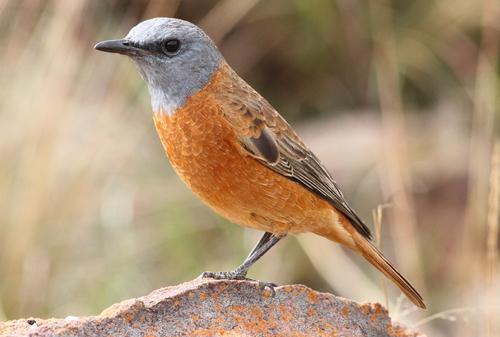 Cape Rock ThrushMonticola rupestrisThis bird is large and stocky for a rock thrush, measuring 21-22 cm (8.26in) in length.
 Blue-capped Rock ThrushMonticola cinclorhynchaThe male has a blue head, chin and throat.
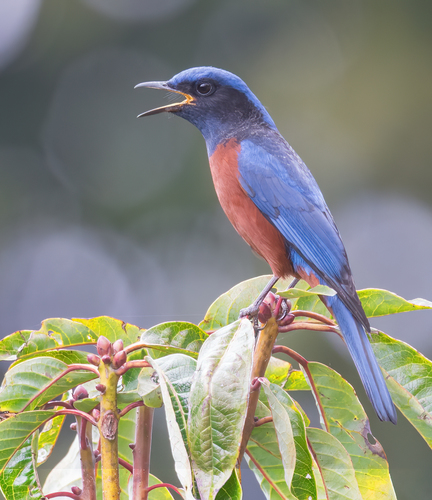 Chestnut-bellied Rock ThrushMonticola rufiventrisThe chestnut-bellied rock thrush is 21–23 cm (8.3–9.1 in) in overall length and weighs 48–61 g (1.7–2.2 oz).
Side by side: Blue Rock Thrush vs Common Rock Thrush · Cape Rock Thrush vs Common Rock Thrush · Blue-capped Rock Thrush vs Common Rock Thrush · Chestnut-bellied Rock Thrush vs Common Rock Thrush
Learn the Common Rock Thrush in the BeakBrain App
Photo and call practice. Coming soon to iPhone and Android.
Play today's Daily BirdEvery photo and recording on this page is credited to its author under the licence shown. Spotted a problem with this page, or have a better photo? Contribute.