Learn what every symbol on the card means.Full credits and sources at beakbrain.com/symbols
 CoastalScrapeMedium · 64 g







What the Common Ringed Plover sounds like


ID tip
Adults are 17–19.5 cm (6.7–7.7 in) in length with a 35–41 cm (14–16 in) wingspan. They have a grey-brown back and wings, a white belly, and a white breast with one black neckband. They have a brown cap, a white forehead, a black mask around the eyes and a short orange and black bill. The legs are orange and only the outer two toes are slightly webbed, unlike the slightly smaller but otherwise very similar semipalmated plover, which has all three toes slightly webbed, and also a marginally narrower breast band; it was in former times included in the present species.
Text from Wikipedia, licensed CC BY-SA 4.0.
When to see the Common Ringed Plover
One bar for each month. Filled bars are the 8 months with records; pale bars are months with none. The wide bar is August, the month with the most records.
Where to see the Common Ringed Plover
The map shades 138 countries with regular records, and 7 more in a lighter tone where the bird turns up only as a stray. Everything unshaded has no records. Countries are listed below the map.
Recorded as a rare visitor in United States, Luxembourg, Central African Republic, South Sudan, Maldives, Tajikistan, Turkmenistan.
About the Common Ringed Plover
The common ringed plover, great ringed plover or ringed plover is a species of bird in the family Charadriidae. It breeds across much of northern Eurasia, as well as Greenland.
Text adapted from Wikipedia, licensed CC BY-SA 4.0.
Easily confused with
 Semipalmated PloverCharadrius semipalmatusThis species weighs a mean 47.4 g (1.7 oz.) for males and 46.1 g (1.6 oz.) for females, with body masses ranging from 37.6-54.7 g (1.3-1.9 oz.). and measures 17–19 cm (6.7–7.5 in) in length with a 12–13 cm (4.7–5.1 in) mean wing length.
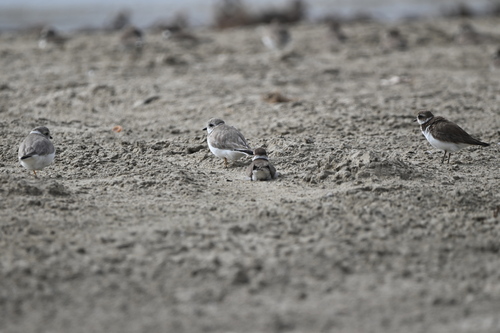 Piping PloverCharadrius melodusThe piping plover is a stout bird with a large rounded head, a short thick neck, and a stubby bill.
 KilldeerCharadrius vociferusThe killdeer is a tall and slender plover, with a relatively long tail.
Side by side: Common Ringed Plover vs Killdeer · Common Ringed Plover vs Semipalmated Plover · Common Ringed Plover vs Piping Plover
Learn the Common Ringed Plover in the BeakBrain App
Photo and call practice. Coming soon to iPhone and Android.
Play today's Daily BirdEvery photo and recording on this page is credited to its author under the licence shown. Spotted a problem with this page, or have a better photo? Contribute.