Learn what every symbol on the card means.Full credits and sources at beakbrain.com/symbols
 RiverineCavity nestSmall · 31 g







What the Common Kingfisher sounds like


ID tip
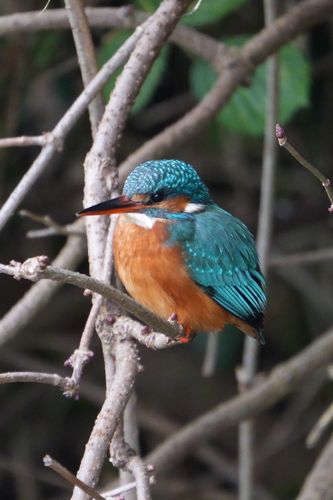
This species has the typical short-tailed, dumpy-bodied, large-headed, and long-billed kingfisher shape. The adult male of the western European subspecies, A. a. ispida has green-blue upperparts with pale azure-blue back and rump, a rufous patch by the bill base, and a rufous ear-patch. It has a green-blue neck stripe, white neck blaze and throat, rufous underparts, and a black bill with some red at the base. The legs and feet are bright red. It is about 16 cm (6+1⁄2 in) long with a wingspan of 25 cm (10 in), and weighs 34–46 g (1+3⁄16–1+5⁄8 oz).
Text from Wikipedia, licensed CC BY-SA 4.0.
When to see the Common Kingfisher
One bar for each month, and every month is filled: this bird is recorded here in all twelve. The wide bar is January, the month with the most records.
Where to see the Common Kingfisher
The map shades 104 countries with regular records, and 3 more in a lighter tone where the bird turns up only as a stray. Everything unshaded has no records. Countries are listed below the map.
About the Common Kingfisher
The common kingfisher, also known as the Eurasian kingfisher and river kingfisher, is a small kingfisher with seven subspecies recognized within its wide distribution across Eurasia and North Africa. It is resident in much of its range, but migrates from areas where rivers freeze in winter.
Text adapted from Wikipedia, licensed CC BY-SA 4.0.
Easily confused with
 Blue-eared KingfisherAlcedo menintingThis 16 centimetres (6.3 in) long kingfisher is almost identical to the common kingfisher (Alcedo atthis) but is distinguished by the blue ear coverts, darker and more intense cobalt-blue upperparts with richer rufous under parts.
 Half-collared KingfisherAlcedo semitorquataThe half-collared kingfisher is a medium-sized kingfisher.
 Cerulean KingfisherAlcedo coerulescensThe cerulean kingfisher is a small kingfisher with a length of 13 cm (5.1 in).
Side by side: Blue-eared Kingfisher vs Common Kingfisher · Common Kingfisher vs Half-collared Kingfisher · Cerulean Kingfisher vs Common Kingfisher
Learn the Common Kingfisher in the BeakBrain App
Photo and call practice. Coming soon to iPhone and Android.
Play today's Daily BirdEvery photo and recording on this page is credited to its author under the licence shown. Spotted a problem with this page, or have a better photo? Contribute.