Learn what every symbol on the card means.Full credits and sources at beakbrain.com/symbols
 ForestCavity nestMedium · 192 g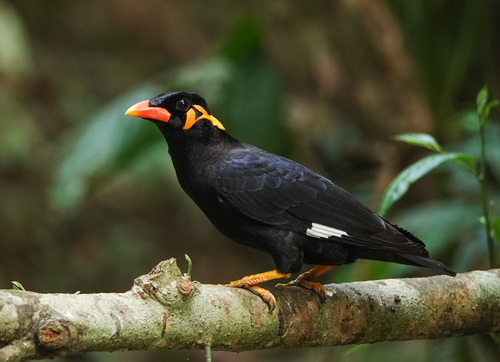
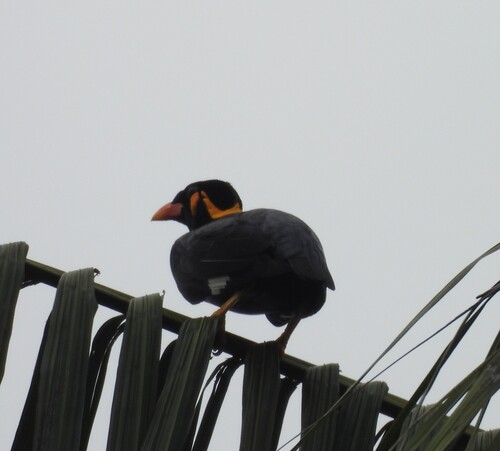
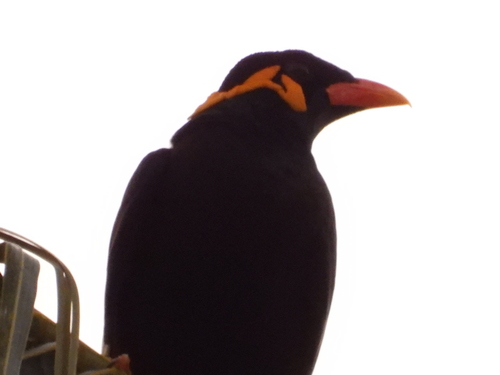
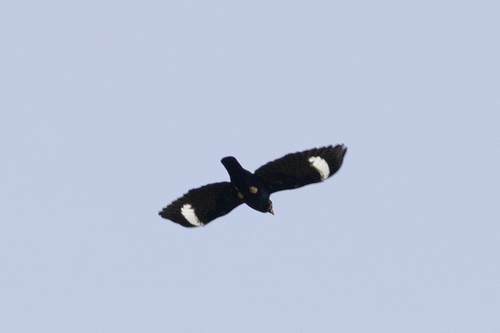
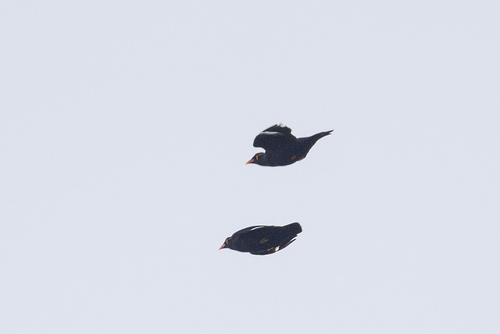


ID tip
This is a stocky jet-black myna, with bright orange-yellow patches of naked skin and fleshy wattles on the side of its head and nape. At about 29 cm length, it is somewhat larger than the common myna (Acridotheres tristis). It is overall green-glossed black plumage, purple-tinged on the head and neck. Its large, white wing patches are obvious in flight, but mostly covered when the bird is sitting. The bill and strong legs are bright yellow, and there are yellow wattles on the nape and under the eye. Voice: The common hill myna is often detected by its loud, shrill, descending whistles followed by other calls. It is most vocal at dawn and dusk, when it is found in small groups in forest clearings high in the canopy. Both sexes can produce an extraordinarily wide range of loud calls – whistles, wails, screeches, and gurgles, sometimes melodious and often very human-like in quality.
Text from Wikipedia, licensed CC BY-SA 4.0.
When to see the Common Hill Myna
One bar for each month. Filled bars are the 9 months with records; pale bars are months with none. The wide bar is February, the month with the most records.
Where to see the Common Hill Myna
The map shades 20 countries with regular records, and 5 more in a lighter tone where the bird turns up only as a stray. Everything unshaded has no records. Countries are listed below the map.
Recorded as a rare visitor in United States, France, Puerto Rico, Sri Lanka, Vietnam.
About the Common Hill Myna
The common hill myna, sometimes spelled "mynah" and formerly simply known as the hill myna or myna bird, is a species of starling found in the hills of South and Southeast Asia. The Sri Lanka hill myna, a former subspecies of G. religiosa, is now generally accepted as a separate species G. ptilogenys. The Nias hill myna are also widely accepted as specifically distinct, and many authors favor treating the southern hill myna from the Nilgiris and elsewhere in the Western Ghats of India as a separate species.
Text adapted from Wikipedia, licensed CC BY-SA 4.0.
Easily confused with
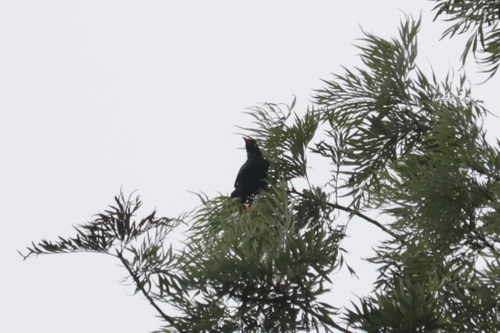 Southern Hill MynaGracula indicaThe southern hill myna has a shiny black plumage.
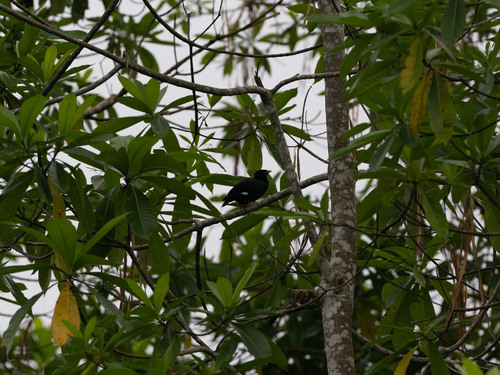 Sri Lanka Hill MynaGracula ptilogenysThe Sri Lanka hill myna or Ceylon myna is a myna, a member of the starling family.
Tenggara Hill MynaGracula venerataThe Tenggara hill myna is a member of the starling family.
Sri Lanka Hill MynaGracula ptilogenysThe Sri Lanka hill myna or Ceylon myna is a myna, a member of the starling family.
Tenggara Hill MynaGracula venerataThe Tenggara hill myna is a member of the starling family.
Side by side: Common Hill Myna vs Southern Hill Myna
Learn the Common Hill Myna in the BeakBrain App
Photo and call practice. Coming soon to iPhone and Android.
Play today's Daily BirdEvery photo and recording on this page is credited to its author under the licence shown. Spotted a problem with this page, or have a better photo? Contribute.