Learn what every symbol on the card means.Full credits and sources at beakbrain.com/symbols
 ForestSmall · 17 g

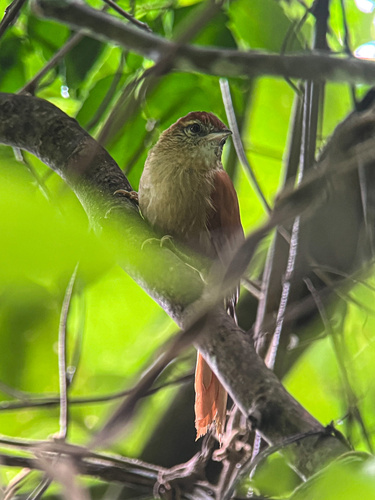
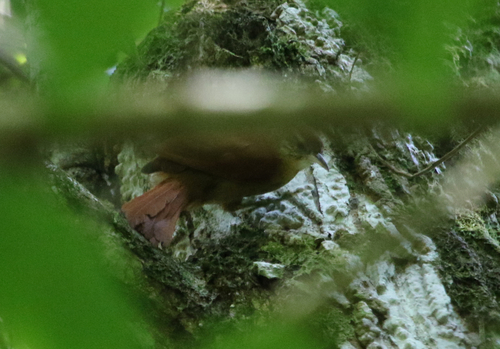
ID tip
The Coiba spinetail is 15 to 16 cm (5.9 to 6.3 in) long. Its upperparts including the tail are russet brown, though the rump is somewhat paler. Most of the face is a dull creamy buff with a bit of gray and a pinkish buff supercilium. Its throat is white, the breast and belly white with a buff wash, and the flanks tawny. Voice: The Coiba spinetail's song is "2-4 short introductory notes, followed by 4-6 longer notes given rapidly at the same pitch followed by about 7 even longer notes that slow down and fall in pitch." Both sexes sing, but it appears that one sex's song is stronger and clearer than the other's. Two calls are known, a "chidididit" and a "deet-deet-dee-dididit".
Text from Wikipedia, licensed CC BY-SA 4.0.
When to see the Coiba Spinetail
One bar for each month. Filled bars are the 10 months with records; pale bars are months with none. The wide bar is March, the month with the most records.
Where to see the Coiba Spinetail
The map shades 1 country with regular records. Everything unshaded has no records. Countries are listed below the map.
About the Coiba Spinetail
The Coiba spinetail is a member of the family Furnariidae (ovenbirds) that is endemic to Coiba and Ranchería Islands, Panama.
Text adapted from Wikipedia, licensed CC BY-SA 4.0.
Easily confused with
 Bolivian SpinetailCranioleuca henricaeThe Bolivian spinetail is 14.5 to 15 cm (5.7 to 5.9 in) long.
Scaled SpinetailCranioleuca muelleriThe scaled spinetail is a dark bird with scaly-looking undersides, a pale supercilium, dark brown upperparts and rufuous crown, wings and tail.
Bolivian SpinetailCranioleuca henricaeThe Bolivian spinetail is 14.5 to 15 cm (5.7 to 5.9 in) long.
Scaled SpinetailCranioleuca muelleriThe scaled spinetail is a dark bird with scaly-looking undersides, a pale supercilium, dark brown upperparts and rufuous crown, wings and tail.
Learn the Coiba Spinetail in the BeakBrain App
Photo and call practice. Coming soon to iPhone and Android.
Play today's Daily BirdEvery photo and recording on this page is credited to its author under the licence shown. Spotted a problem with this page, or have a better photo? Contribute.