Learn what every symbol on the card means.Full credits and sources at beakbrain.com/symbols
 WoodlandSmall · 17 g
ID tip
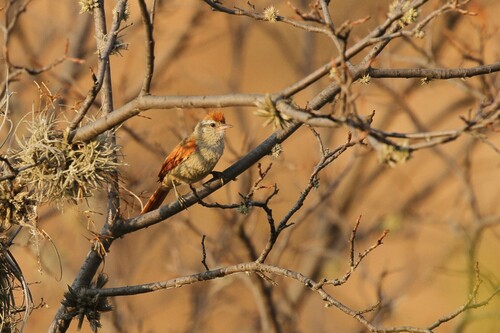
The Bolivian spinetail is 14.5 to 15 cm (5.7 to 5.9 in) long. The sexes have the same plumage. Adults have a white supercilium and dirty white lores with black tips on an otherwise gray face. Their crown is rufous with buff and gray speckles on the forecrown. Their nape and back are light brownish olive, their rump tawny olive, and their uppertail coverts cinnamon brown. Their tail is rufous with a faint dusky wash on the innermost pair of feathers. Their wings are rufous with grayish brown inner webs on the primary coverts and fuscous tips to the flight feathers. Voice: The Bolivian spinetail's "short song" is "a bouncy, accelerating and descending series, lasting from 1 s to 2.5 s, rarely up to 3.8 s". Its "long song" is an "irregular and fast series ... from 3.5-13.5 s. Most songs wind up and down in pitch but with an overall tendency to descend". Its calls are "single notes, double or triple notes, or as a short churr".
Text from Wikipedia, licensed CC BY-SA 4.0.
When to see the Bolivian Spinetail
One bar for each month. Filled bars are the 7 months with records; pale bars are months with none. The wide bar is October, the month with the most records.
Where to see the Bolivian Spinetail
The map shades 1 country with regular records. Everything unshaded has no records. Countries are listed below the map.
About the Bolivian Spinetail
The Bolivian spinetail is a vulnerable species of bird in the Furnariinae subfamily of the ovenbird family Furnariidae. It is endemic to Bolivia.
Text adapted from Wikipedia, licensed CC BY-SA 4.0.
Easily confused with
 Coiba SpinetailCranioleuca dissitaThe Coiba spinetail is 15 to 16 cm (5.9 to 6.3 in) long.
Vilcabamba SpinetailCranioleuca weskeiThe Vilcabamba spinetail is 14.5 to 16 cm (5.7 to 6.3 in) long and weighs about 20 g (0.71 oz).
Coiba SpinetailCranioleuca dissitaThe Coiba spinetail is 15 to 16 cm (5.9 to 6.3 in) long.
Vilcabamba SpinetailCranioleuca weskeiThe Vilcabamba spinetail is 14.5 to 16 cm (5.7 to 6.3 in) long and weighs about 20 g (0.71 oz).
Learn the Bolivian Spinetail in the BeakBrain App
Photo and call practice. Coming soon to iPhone and Android.
Play today's Daily BirdEvery photo and recording on this page is credited to its author under the licence shown. Spotted a problem with this page, or have a better photo? Contribute.