Learn what every symbol on the card means.Full credits and sources at beakbrain.com/symbols
 ForestPlatform nestMedium · 70 g
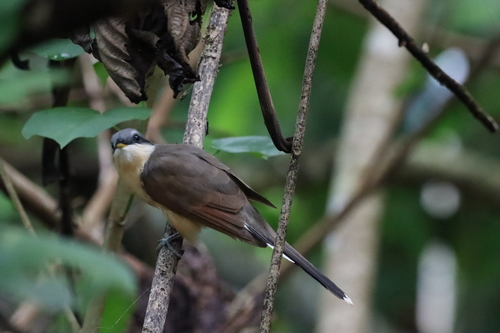
ID tip
The Cocos cuckoo is 32 to 33 cm (13 to 13 in) long, about half of which is the tail, and weighs about 70 g (2.5 oz). Their bill is stout and somewhat decurved. Its maxilla is black and its mandible yellow to yellow-orange with a black tip. Males and females have the same plumage. Adults' forehead and crown are slate gray and their upperparts grayish brown. Their wings are rufous. The upper surface of their tail is grayish brown and the undersides black with wide white tips. Voice: As of late 2022, xeno-canto had no recordings of the Cocos cuckoo's vocalizations and the Cornell Lab of Ornithology's Macaulay Library had only three. The song is described as "a guttural Eeh-eeh-eeh-eeh-eeh-eeeh-eeeehh" and is most frequently sung during the breeding season, and then between dawn and noon.
Text from Wikipedia, licensed CC BY-SA 4.0.
When to see the Cocos Cuckoo
One bar for each month. Filled bars are the 8 months with records; pale bars are months with none. The wide bar is April, the month with the most records.
Where to see the Cocos Cuckoo
The map shades 1 country with regular records. Everything unshaded has no records. Countries are listed below the map.
About the Cocos Cuckoo
The Cocos cuckoo is a Vulnerable species of bird in the tribe Phaenicophaeini, subfamily Cuculinae of the cuckoo family Cuculidae. It is endemic to Cocos Island, an island in the Pacific Ocean which is part of Costa Rica.
Text adapted from Wikipedia, licensed CC BY-SA 4.0.
Easily confused with
 Bay-breasted CuckooCoccyzus rufigularisThe bay-breasted cuckoo is 46 to 51 cm (18 to 20 in) long, about half of which is the tail.
 Pearly-breasted CuckooCoccyzus euleriThe pearly-breasted cuckoo is 25 to 28 cm (9.8 to 11 in) long, about half of which is the tail.
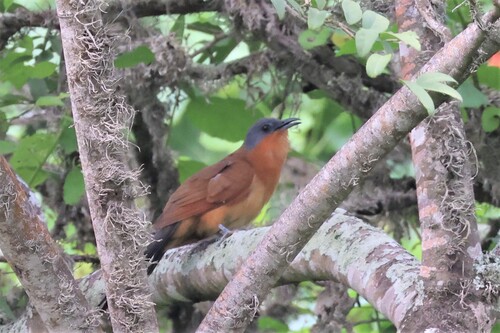 Grey-capped CuckooCoccyzus lansbergiThe grey-capped cuckoo is 25 to 28 cm (9.8 to 11 in) long, about half of which is the tail.
Learn the Cocos Cuckoo in the BeakBrain App
Photo and call practice. Coming soon to iPhone and Android.
Play today's Daily BirdEvery photo and recording on this page is credited to its author under the licence shown. Spotted a problem with this page, or have a better photo? Contribute.