Learn what every symbol on the card means.Full credits and sources at beakbrain.com/symbols
 WoodlandPlatform nestSmall · 50 g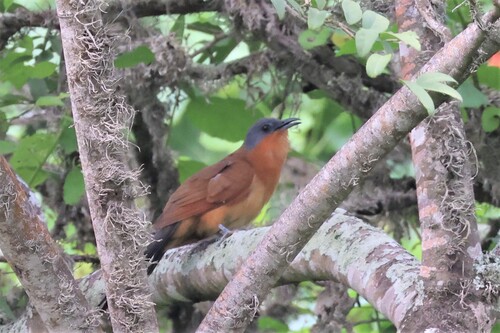
ID tip
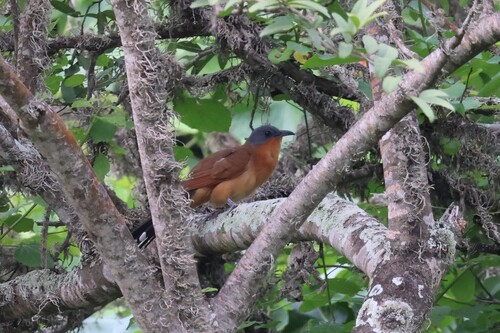
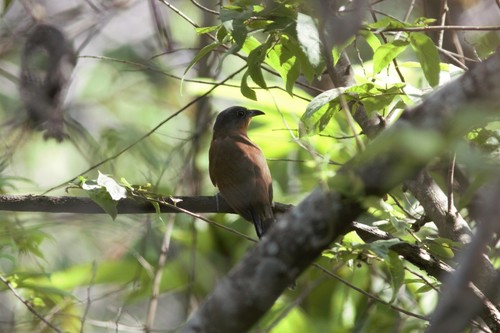
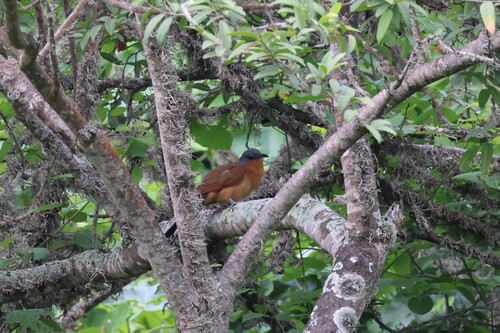
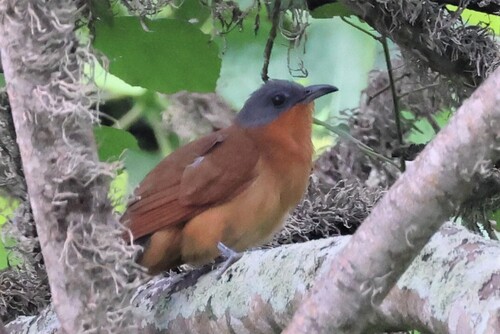
The grey-capped cuckoo is 25 to 28 cm (9.8 to 11 in) long, about half of which is the tail. Males weigh 46 to 56 g (1.6 to 2.0 oz). The species' bill is stout, somewhat decurved, and black with sometimes a gray or yellow spot at the base of the mandible. Males and females have the same plumage. Adults have a slate-gray cap to below the eye. Their upperparts and wings are rufous brown. The upper surface of their tail is black; the underside of the central pair of feathers is black and the rest black with white tips. Voice: The grey-capped cuckoo's song is a "ast series of 6–8 hollow and falling 'cu' notes, often with a slight pause before the last note, e.g., 'cucucucucucucu-cu'." It may be repeated several times during each song bout.
Text from Wikipedia, licensed CC BY-SA 4.0.
When to see the Grey-capped Cuckoo
One bar for each month. Filled bars are the 9 months with records; pale bars are months with none. The wide bar is March, the month with the most records.
Where to see the Grey-capped Cuckoo
The map shades 5 countries with regular records. Everything unshaded has no records. Countries are listed below the map.
About the Grey-capped Cuckoo
The grey-capped cuckoo is a species of bird in the tribe Phaenicophaeini, subfamily Cuculinae of the cuckoo family Cuculidae. It is found in Colombia, Ecuador, Peru, and Venezuela, as a vagrant on Bonaire and in the Galápagos Islands, and possibly in Panama.
Text adapted from Wikipedia, licensed CC BY-SA 4.0.
Easily confused with
 Pearly-breasted CuckooCoccyzus euleriThe pearly-breasted cuckoo is 25 to 28 cm (9.8 to 11 in) long, about half of which is the tail.
 Jamaican Lizard CuckooCoccyzus vetulaThe Jamaican lizard cuckoo is 38 to 40 cm (15 to 16 in) long, about half of which is the tail, and weighs 86 to 105 g (3.0 to 3.7 oz).
 Chestnut-bellied CuckooCoccyzus pluvialisThe chestnut-bellied cuckoo is 48 to 56 cm (19 to 22 in) long, about half of which is the tail, and weighs 130 to 189 g (4.6 to 6.7 oz).
Learn the Grey-capped Cuckoo in the BeakBrain App
Photo and call practice. Coming soon to iPhone and Android.
Play today's Daily BirdEvery photo and recording on this page is credited to its author under the licence shown. Spotted a problem with this page, or have a better photo? Contribute.