Learn what every symbol on the card means.Full credits and sources at beakbrain.com/symbols
 WetlandScrapeLarge · 923 g



ID tip
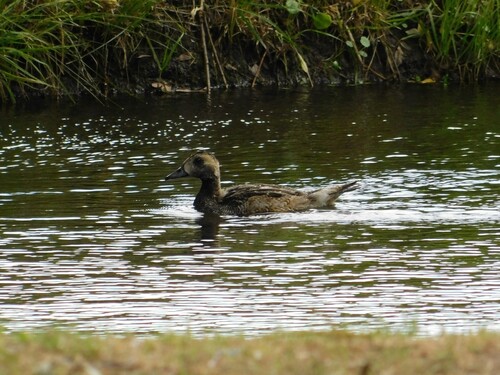
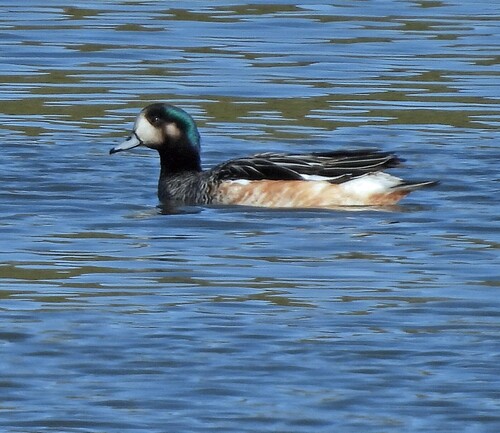
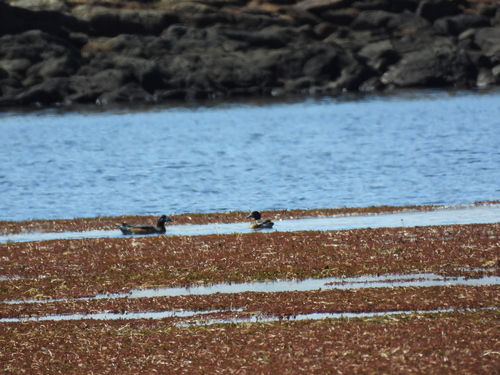
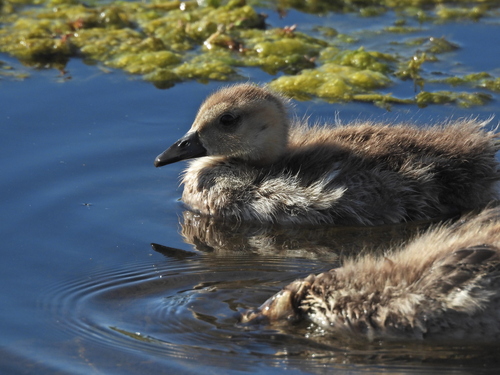
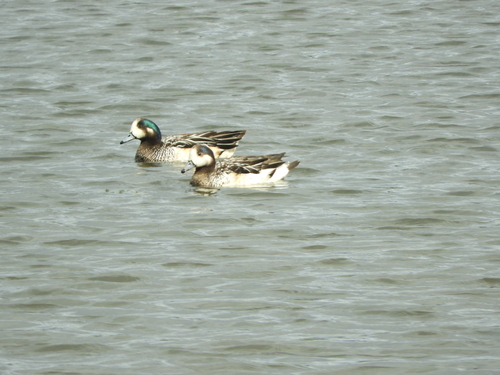
The Chiloé wigeon has a body length of 46 to 56 cm (18 to 22 in) and a wingspan of 75 to 86 cm (30 to 34 in). The wing length is about 25 cm (9.8 in) and the weight is approximately 800 g (28 oz). This bird has an iridescent green-blue cap on its head, and a bluish gray bill with a black tip. The cheeks and forehead are white, the eyes are dark brown, and there is a white auricular patch. The neck and occipital part of the head are black. The breast is barred black and white and the plumage of the wings is gray and white. The flanks of males are rust colored, and light brown on females.
Text from Wikipedia, licensed CC BY-SA 4.0.
When to see the Chiloe Wigeon
One bar for each month. Filled bars are the 11 months with records; pale bars are months with none. The wide bar is October, the month with the most records.
Where to see the Chiloe Wigeon
The map shades 11 countries with regular records, and 14 more in a lighter tone where the bird turns up only as a stray. Everything unshaded has no records. Countries are listed below the map.
Recorded as a rare visitor in Belgium, Norway, France, Spain, United States, Sweden, United Kingdom, Brazil, Canada, Netherlands, Portugal, Peru, Italy, Lithuania.
About the Chiloe Wigeon
The Chiloé wigeon, also known as the southern wigeon, is one of three extant species of wigeon in the genus Mareca of the dabbling duck subfamily. This bird is indigenous to the southern part of South America, including the Chiloé Archipelago, from which it gets its name. In its native range, it is called the pato overo or pato real, although the latter name also refers to the Muscovy in the wild. Its specific epithet, sibilatrix, means 'whistler', referring to the bird's call.
Text adapted from Wikipedia, licensed CC BY-SA 4.0.
Easily confused with
 Falcated DuckMareca falcataMales and females have similar lengths at 46 to 53 cm (18–21 in).
 Eurasian WigeonMareca penelopeThis dabbling duck is 42–52 cm (17–20 in) long with a 71–80 cm (28–31 in) wingspan, and a weight of 500–1,073 g (1–2 lb).
 American WigeonMareca americanaThe American wigeon is a medium-sized bird; it is larger than a teal but smaller than a pintail.
Side by side: Chiloe Wigeon vs Gadwall · American Wigeon vs Chiloe Wigeon · Chiloe Wigeon vs Eurasian Wigeon · Chiloe Wigeon vs Pink-eared Duck · Chiloe Wigeon vs Falcated Duck
Learn the Chiloe Wigeon in the BeakBrain App
Photo and call practice. Coming soon to iPhone and Android.
Play today's Daily BirdEvery photo and recording on this page is credited to its author under the licence shown. Spotted a problem with this page, or have a better photo? Contribute.