Learn what every symbol on the card means.Full credits and sources at beakbrain.com/symbols
 CoastalScrapeLarge · 599 g


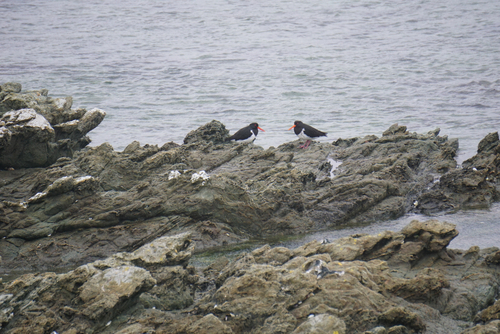


ID tip
The Chatham Islands oystercatcher has distinctive black and white plumage and a long, thick orange-red beak. The head, neck, breast, back, wings and tail are black. The lower underparts are white with an unclear demarcation on the breast. The irises are red and the eyes have orange orbital rings. The short, thick legs are pink. Adults are about 48 centimetres (19 in) in length.
Text from Wikipedia, licensed CC BY-SA 4.0.
When to see the Chatham Islands Oystercatcher
One bar for each month. Filled bars are the 8 months with records; pale bars are months with none. The wide bar is December, the month with the most records.
Where to see the Chatham Islands Oystercatcher
The map shades 1 country with regular records. Everything unshaded has no records. Countries are listed below the map.
About the Chatham Islands Oystercatcher
The Chatham Islands oystercatcher or tōrea tai (Māori), formerly known as the Chatham oystercatcher, is a species of oystercatcher. It is a wading bird endemic to the Chatham Islands, New Zealand. This species is rated by the IUCN as endangered, and has a current population of 310 to 325 birds. The main threat is from introduced predators.
Text adapted from Wikipedia, licensed CC BY-SA 4.0.
Easily confused with
 Magellanic OystercatcherHaematopus leucopodusThe Magellanic oystercatcher has a length between 42 and 46 cm (17 and 18 in).
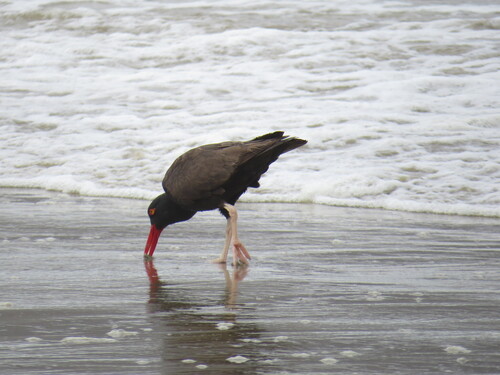 Blackish OystercatcherHaematopus aterThe blackish oystercatcher's plumage is slaty-black with wings and back rather dark brown.
 African OystercatcherHaematopus moquiniThe African oystercatcher is a large, noisy wader, with completely black plumage, red legs and a strong broad red bill.
Learn the Chatham Islands Oystercatcher in the BeakBrain App
Photo and call practice. Coming soon to iPhone and Android.
Play today's Daily BirdEvery photo and recording on this page is credited to its author under the licence shown. Spotted a problem with this page, or have a better photo? Contribute.