Learn what every symbol on the card means.Full credits and sources at beakbrain.com/symbols
 GrasslandPlatform nestHuge · 8.2 kg


ID tip
This large vulture is of a creamy-buff colour, with contrasting dark flight and tail feathers. The adult is paler than the juvenile, and its underwing coverts can appear almost white at a distance. The head and neck are near-naked. The eyes are yellowish, and the bill is black. Juveniles and immatures are generally darker and more streaked, with brown to orange eyes and red necks. It closely resembles the white-backed vulture, however it is larger and has yellow irises. The average length of adult vultures is about 96–115 cm (38–45 in) with a wingspan of 2.26–2.
Text from Wikipedia, licensed CC BY-SA 4.0.
When to see the Cape Vulture
One bar for each month, and every month is filled: this bird is recorded here in all twelve. The wide bar is January, the month with the most records.
Where to see the Cape Vulture
The map shades 8 countries with regular records. Everything unshaded has no records. Countries are listed below the map.
About the Cape Vulture
The Cape vulture, also known as Cape griffon and Kolbe's vulture, is an Old World vulture in the family Accipitridae. It is endemic to southern Africa, and lives mainly in South Africa, Lesotho, Botswana, and in some parts of northern Namibia. It nests on cliffs and lays one egg per year. In 2015, it had been classified as Endangered on the IUCN Red List, but was down-listed to Vulnerable in 2021 as some populations increased and have been stable since about 2016.
Text adapted from Wikipedia, licensed CC BY-SA 4.0.
Easily confused with
 Himalayan VultureGyps himalayensisThe Himalayan vulture has dark brown greater covert feathers, tail and wing quills, but a pale buff uniform upperside and paler tipped inner secondaries; its legs are covered with buffy feathers and vary in colour from greenish grey to pale brown.
 Rüppell's VultureGyps rueppelliThe Rüppell's vulture is a very large vulture, noticeably outsizing the closely related white-backed vulture, with which they often occur in the wild.
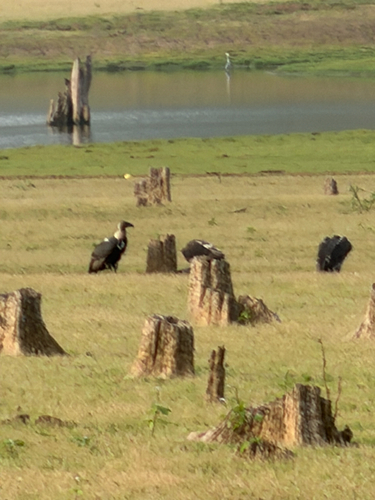 White-rumped VultureGyps bengalensisThe white-rumped vulture is the smallest of the Gyps vultures, but is still a very large bird.
Side by side: Cape Vulture vs Griffon Vulture · Cape Vulture vs White-backed Vulture · Cape Vulture vs Himalayan Vulture · Cape Vulture vs Rüppell's Vulture · Cape Vulture vs White-rumped Vulture
Learn the Cape Vulture in the BeakBrain App
Photo and call practice. Coming soon to iPhone and Android.
Play today's Daily BirdEvery photo and recording on this page is credited to its author under the licence shown. Spotted a problem with this page, or have a better photo? Contribute.