Learn what every symbol on the card means.Full credits and sources at beakbrain.com/symbols
 GrasslandPlatform nestHuge · 4.4 kg

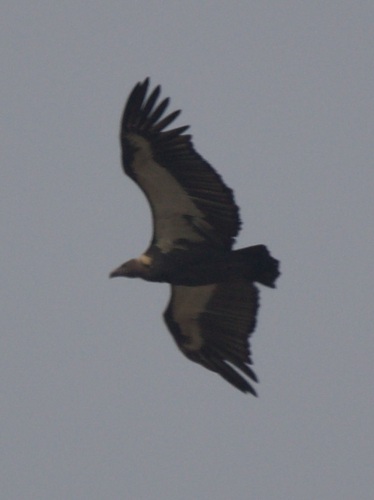






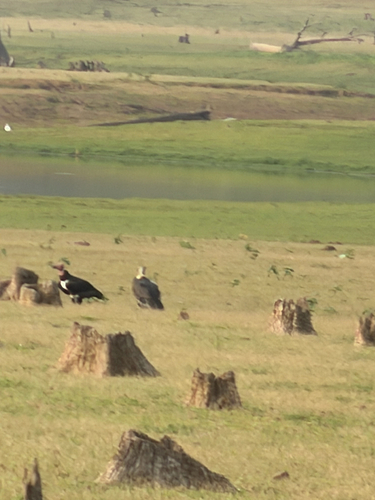
ID tip
The white-rumped vulture is the smallest of the Gyps vultures, but is still a very large bird. It weighs 3.5–7.5 kg (7.7–16.5 lb), measures 75–93 cm (30–37 in) in length, and has a wingspan of 1.92–2.6 m (6.3–8.5 ft). It has an unfeathered head and neck, very broad wings, and short tail feathers. It is much smaller than the Eurasian Griffon. It has a white neck ruff. The adult's whitish back, rump, and underwing coverts contrast with the otherwise dark plumage. The body is black and the secondaries are silvery grey. The head is tinged in pink and bill is silvery with dark ceres.
Text from Wikipedia, licensed CC BY-SA 4.0.
When to see the White-rumped Vulture
One bar for each month. Filled bars are the 9 months with records; pale bars are months with none. The wide bar is February, the month with the most records.
Where to see the White-rumped Vulture
The map shades 6 countries with regular records, and 2 more in a lighter tone where the bird turns up only as a stray. Everything unshaded has no records. Countries are listed below the map.
About the White-rumped Vulture
The white-rumped vulture is an Old World vulture native to South and Southeast Asia. It has been listed as Critically Endangered on the IUCN Red List since 2000, as the population severely declined. White-rumped vultures are threatened by diclofenac poisoning, which kills them by causing kidney failure. As of 2021, the global population was estimated at less than 6,000 mature individuals. In comparison, during the 1980s, the global population was estimated at several million individuals, and it was thought to be "the most abundant large bird of prey in the world".
Text adapted from Wikipedia, licensed CC BY-SA 4.0.
Easily confused with
 Indian VultureGyps indicusThe Indian vulture is bulky and medium in size.
 Rüppell's VultureGyps rueppelliThe Rüppell's vulture is a very large vulture, noticeably outsizing the closely related white-backed vulture, with which they often occur in the wild.
 Slender-billed VultureGyps tenuirostrisAt 80 to 95 cm (31 to 37 in), in length, this mid-sized vulture is about the same size as its sister species, the Indian vulture.
Side by side: Himalayan Vulture vs White-rumped Vulture · Cape Vulture vs White-rumped Vulture · Rüppell's Vulture vs White-rumped Vulture · Indian Vulture vs White-rumped Vulture
Learn the White-rumped Vulture in the BeakBrain App
Photo and call practice. Coming soon to iPhone and Android.
Play today's Daily BirdEvery photo and recording on this page is credited to its author under the licence shown. Spotted a problem with this page, or have a better photo? Contribute.