Learn what every symbol on the card means.Full credits and sources at beakbrain.com/symbols
 ShrublandCup nestSmall · 16 g
ID tip
This is a medium-sized warbler, larger than the Eurasian reed warbler. It resembles that bird in appearance, grey-brown above, greyish-white below, with no obvious markings. The geographical isolation of the bird on the Cape Verde Islands prevents confusion with other similar species. The song is a distinctive liquid bubbling, like that of a bulbul.
Text from Wikipedia, licensed CC BY-SA 4.0.
When to see the Cape Verde Warbler
One bar for each month. Filled bars are the 8 months with records; pale bars are months with none. The wide bar is April, the month with the most records.
Where to see the Cape Verde Warbler
The map shades 1 country with regular records. Everything unshaded has no records. Countries are listed below the map.
About the Cape Verde Warbler
The Cape Verde warbler is an Old World warbler in the genus Acrocephalus. It is also known as the Cape Verde cane warbler or Cape Verde swamp warbler, and in Creole as tchota-de-cana or chincherote. It breeds on Santiago, Fogo, and São Nicolau in the Cape Verde Islands. It previously bred on Brava. This species is found in well-vegetated valleys, avoiding drier areas. It nests in reedbeds, two to three eggs being laid in a suspended nest.
Text adapted from Wikipedia, licensed CC BY-SA 4.0.
Easily confused with
 Saipan Reed WarblerAcrocephalus hiwaeThe Saipan reed warbler is approximately 17 cm (6.7 in) long, and is greyish olive-brown above with a pale-yellow underside.
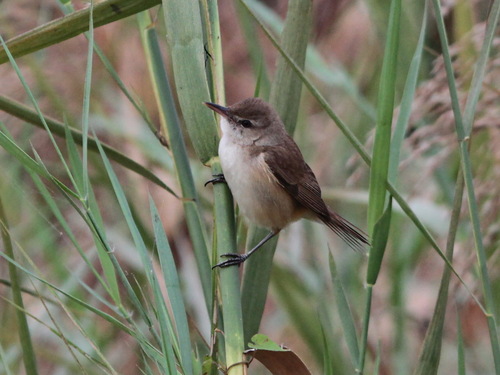 Blunt-winged WarblerAcrocephalus concinensThe blunt-winged warbler is a marsh-warbler.
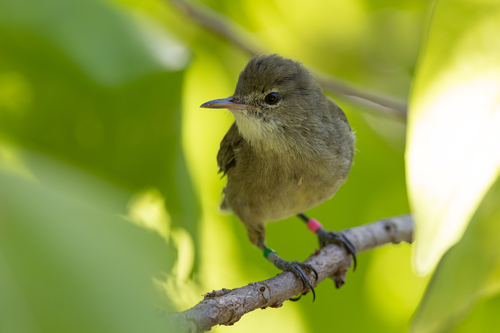 Seychelles WarblerAcrocephalus sechellensisThe Seychelles warbler is a small, plain Acrocephalus warbler, between 13 and 14 cm (5.1–5.5 in) in length and with a wingspan of 17 cm (6.7 in).
Learn the Cape Verde Warbler in the BeakBrain App
Photo and call practice. Coming soon to iPhone and Android.
Play today's Daily BirdEvery photo and recording on this page is credited to its author under the licence shown. Spotted a problem with this page, or have a better photo? Contribute.