Learn what every symbol on the card means.Full credits and sources at beakbrain.com/symbols
 ShrublandScrapeHuge · 3.6 kg




ID tip
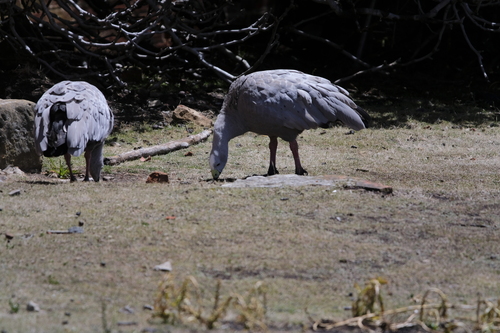
Adult Cape Barren geese are large birds, typically measuring 75–100 cm (30–39 in) long and weighing between 3.7–5.2 kg (8.2–11.5 lb), with males generally being larger than females. The plumage is mostly pale grey with a slight brown tint. The head is somewhat small in proportion to the body and mostly grey in colour, save for a pale whitish patch on the forehead and crown. The bill is short, measuring 56–63 mm (2.2–2.5 in) in length, triangular in shape and black in colour with a prominent pale yellow-green cere covering more than half the length of the bill.
Text from Wikipedia, licensed CC BY-SA 4.0.
When to see the Cape Barren Goose
One bar for each month, and every month is filled: this bird is recorded here in all twelve. The wide bar is January, the month with the most records.
Where to see the Cape Barren Goose
The map shades 3 countries with regular records, and 5 more in a lighter tone where the bird turns up only as a stray. Everything unshaded has no records. Countries are listed below the map.
Recorded as a rare visitor in Germany, Spain, France, United Kingdom, Netherlands.
About the Cape Barren Goose
The Cape Barren goose, sometimes also known as the pig goose, is a species of goose endemic to southern Australia. It is a distinctive large, grey bird that is mostly terrestrial and is not closely related to other extant members of the subfamily Anserinae.
Text adapted from Wikipedia, licensed CC BY-SA 4.0.
Easily confused with
 Falcated DuckMareca falcataMales and females have similar lengths at 46 to 53 cm (18–21 in).
 NeneBranta sandvicensisThe nene is a large-sized goose at 41 cm (16 in) tall.
 Ringed TealCallonetta leucophrysThe ringed teal is 35–38 cm (14–15 in) long, with a 70 cm (28 in) wingspan, and a weight of 190–360 g (6.7–12.7 oz).
Side by side: Cape Barren Goose vs Falcated Duck · Cape Barren Goose vs Nene · Cape Barren Goose vs Ringed Teal
Learn the Cape Barren Goose in the BeakBrain App
Photo and call practice. Coming soon to iPhone and Android.
Play today's Daily BirdEvery photo and recording on this page is credited to its author under the licence shown. Spotted a problem with this page, or have a better photo? Contribute.