Learn what every symbol on the card means.Full credits and sources at beakbrain.com/symbols
 GrasslandPlatform nestHuge · 2.8 kg


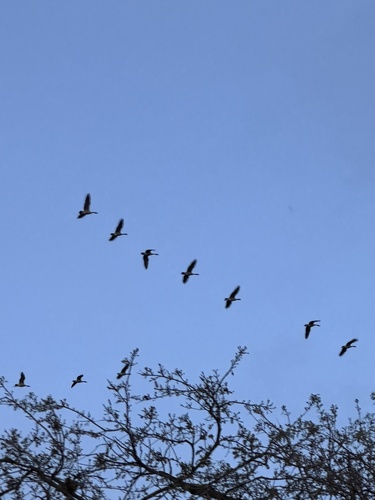
What the Canada Goose sounds like


ID tip
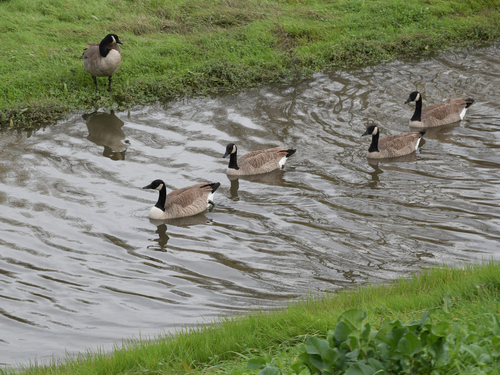
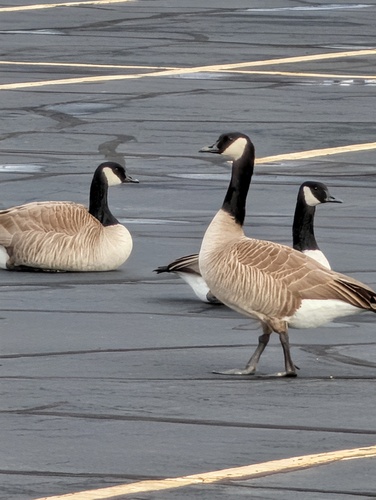
The black head and neck with a white "chinstrap" distinguish the Canada goose from all other goose species except the cackling goose and barnacle goose. (The latter, however, has a black breast and gray rather than brownish body plumage.) Some Canada geese come with a pepper-spotted or brown neck with brown plumage, and these are assumed to be a leucistic variety. On occasion, individuals with dark cheeks, white foreheads or white necks may be seen The seven subspecies of this bird vary widely in size and plumage details but all are recognizable as Canada geese.
Text from Wikipedia, licensed CC BY-SA 4.0.
When to see the Canada Goose
One bar for each month, and every month is filled: this bird is recorded here in all twelve. The wide bar is May, the month with the most records.
Where to see the Canada Goose
The map shades 45 countries with regular records, and 7 more in a lighter tone where the bird turns up only as a stray. Everything unshaded has no records. Countries are listed below the map.
Recorded as a rare visitor in Australia, Japan, Argentina, Belize, South Korea, Türkiye, Jersey.
About the Canada Goose
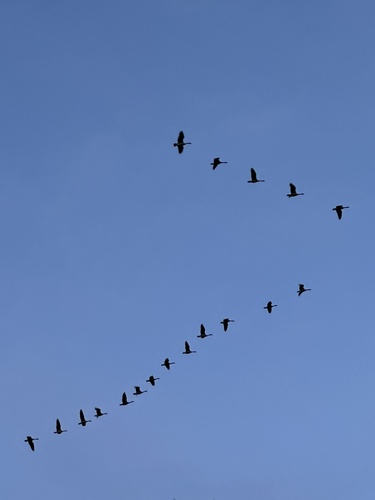
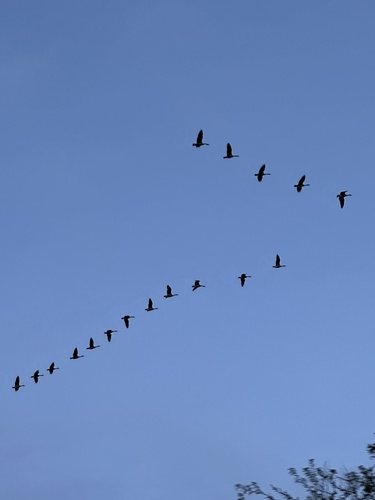
The Canada goose is a large species of goose with a black head and neck, white cheeks, white under its chin, and a brown body. It is native to the Arctic and temperate regions of North America, and it is occasionally found during migration across the Atlantic in northern Europe. It has been introduced to France, the United Kingdom, Ireland, Scandinavia, New Zealand, Japan, Chile, Argentina, and the Falkland Islands. Like most geese, the Canada goose is primarily herbivorous and normally migratory; often found on or close to fresh water, the Canada goose is also common in brackish marshes, estuaries, and lagoons.
Text adapted from Wikipedia, licensed CC BY-SA 4.0.
Easily confused with
 Brant GooseBranta berniclaThe brant is a small goose with a short, stubby bill.
 Cackling GooseBranta hutchinsiiThe black head and neck with white "chinstrap" distinguish this goose from all other geese except the larger Canada goose (Branta canadensis) and the similarly sized barnacle goose (B. leucopsis).
 Barnacle GooseBranta leucopsisThe barnacle goose is a medium-sized goose, 55–70 cm (22–28 in) long, with a wingspan of 120–145 cm (47–57 in) and a weight of 1.21–2.23 kg (2.7–4.9 lb), with black legs and a small, stubby black bill.
Side by side: Brant Goose vs Canada Goose · Cackling Goose vs Canada Goose · Barnacle Goose vs Canada Goose
Watch the Canada Goose on live cams
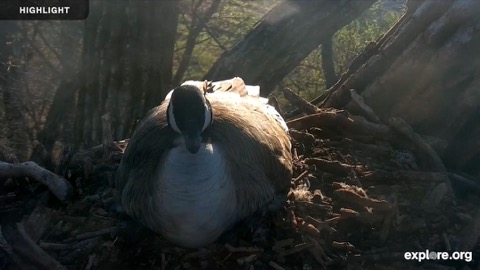 RETURNS MARCH
Browse all 118 bird cams worldwide, live and seasonal, by region and species.
Learn the Canada Goose in the BeakBrain App
Photo and call practice. Coming soon to iPhone and Android.
Play today's Daily BirdEvery photo and recording on this page is credited to its author under the licence shown. Spotted a problem with this page, or have a better photo? Contribute.