Learn what every symbol on the card means.Full credits and sources at beakbrain.com/symbols
 ForestDomed nestSmall · 50 g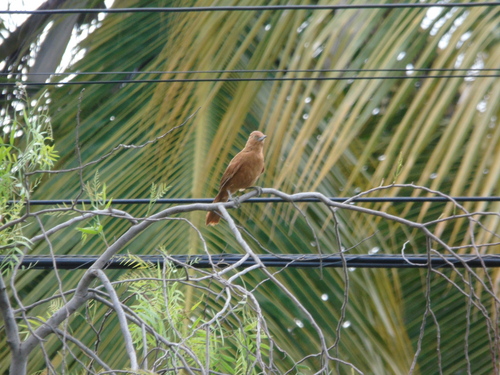
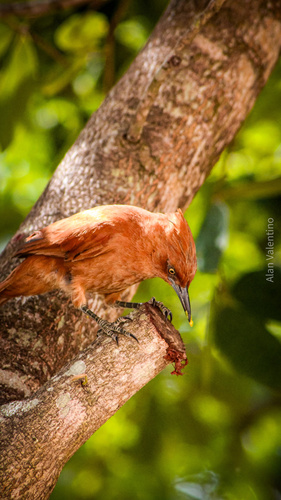


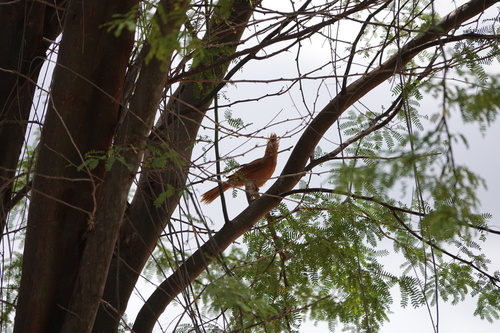
ID tip
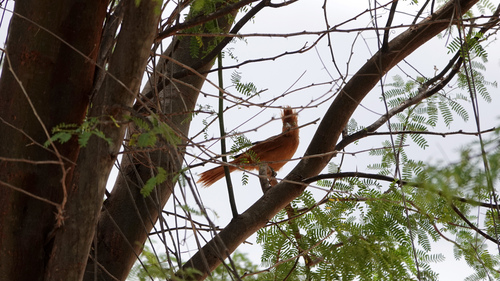
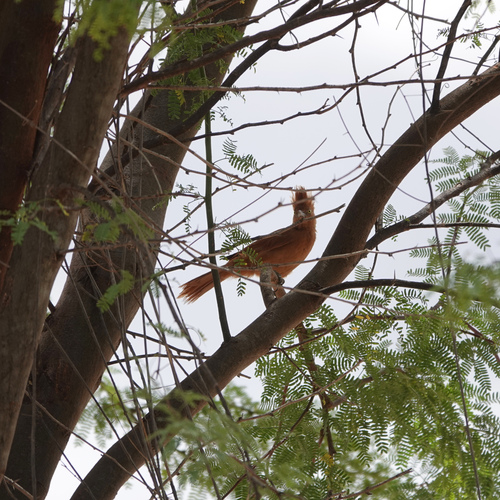
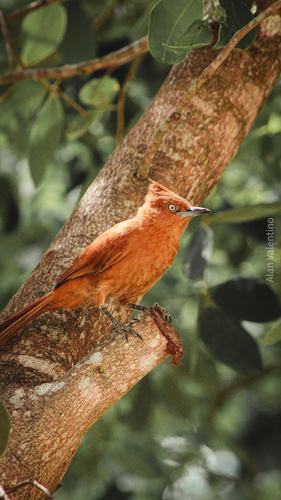
The Caatinga cacholote is 25 to 26 cm (9.8 to 10 in) long. It is a large, crested, furnariid with a long bill. The sexes have the same plumage. Adults are mostly bright reddish-rufous that is somewhat paler on their underparts. Their flight feathers have fuscous tips and the ends of the tail feathers lack barbs. Their iris is yellow. Juveniles have a shorter crest than adults, with some dusky streaks or bars on the face and underparts and a bluish gray iris. Voice: The Caatinga cacholote typically sings in duet. One bird, thought to be the male, "gives a long series of well-spaced, very loud, piercing 'tjew' notes". The presumed female replies with "a series of 15–35 well-spaced buzzy 'zjeep' notes". The species' call is "a single 'chuk' ".
Text from Wikipedia, licensed CC BY-SA 4.0.
When to see the Caatinga Cacholote
One bar for each month, and every month is filled: this bird is recorded here in all twelve. The wide bar is January, the month with the most records.
Where to see the Caatinga Cacholote
The map shades 1 country with regular records. Everything unshaded has no records. Countries are listed below the map.
About the Caatinga Cacholote
The Caatinga cacholote is a species of bird in the Furnariinae subfamily of the ovenbird family Furnariidae. It is endemic to Brazil.
Text adapted from Wikipedia, licensed CC BY-SA 4.0.
Easily confused with
Grey-crested CacholotePseudoseisura unirufaThe grey-crested cacholote is 20 to 21 cm (7.9 to 8.3 in) long and weighs 42 to 57 g (1.5 to 2.0 oz).
 White-throated CacholotePseudoseisura gutturalisThe white-throated cacholote is 22 to 23 cm (8.7 to 9.1 in) long and weighs 63 to 79 g (2.2 to 2.8 oz).
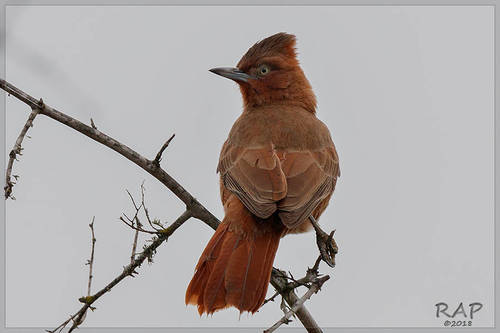 Brown CacholotePseudoseisura lophotesThe brown cacholote ranges from 24 to 26 cm (9.4 to 10 in) in length and weighs 63 to 79 g (2.2 to 2.8 oz), making it one of the largest furnariids.
Side by side: Brown Cacholote vs Caatinga Cacholote · Caatinga Cacholote vs Grey-crested Cacholote · Caatinga Cacholote vs White-throated Cacholote
Learn the Caatinga Cacholote in the BeakBrain App
Photo and call practice. Coming soon to iPhone and Android.
Play today's Daily BirdEvery photo and recording on this page is credited to its author under the licence shown. Spotted a problem with this page, or have a better photo? Contribute.