Learn what every symbol on the card means.Full credits and sources at beakbrain.com/symbols
 WoodlandDomed nestMedium · 72 g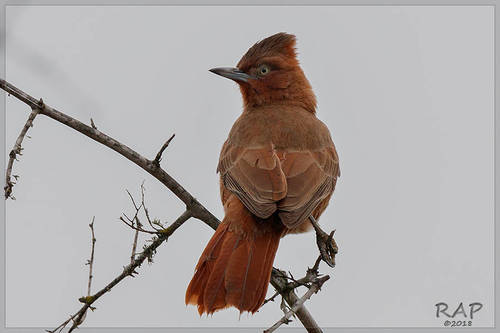
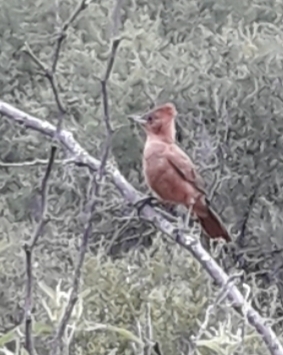
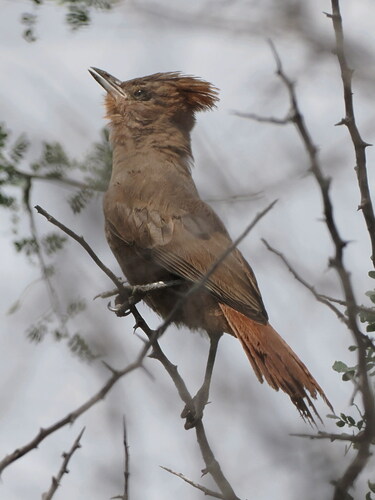
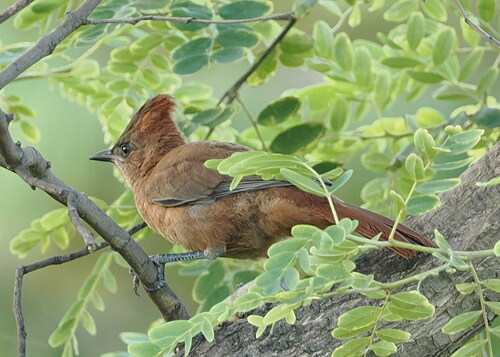
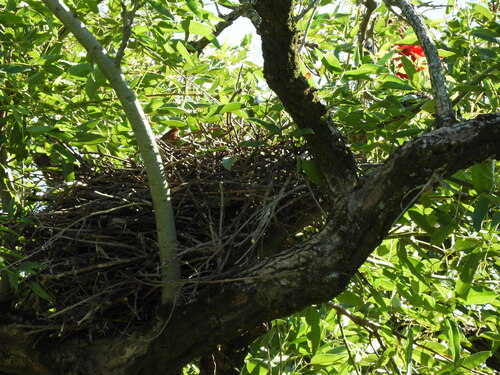
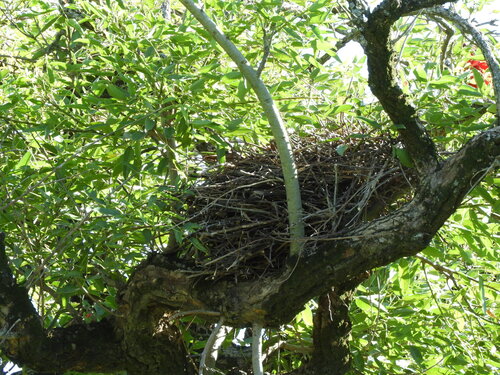

ID tip
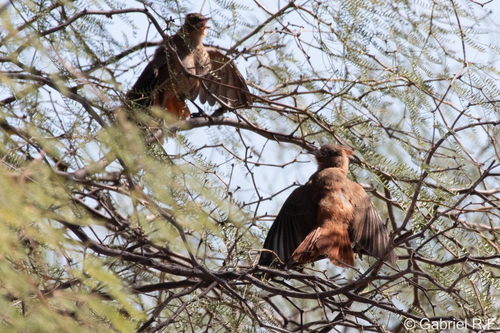
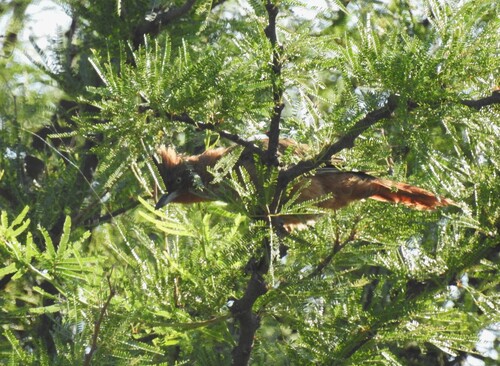
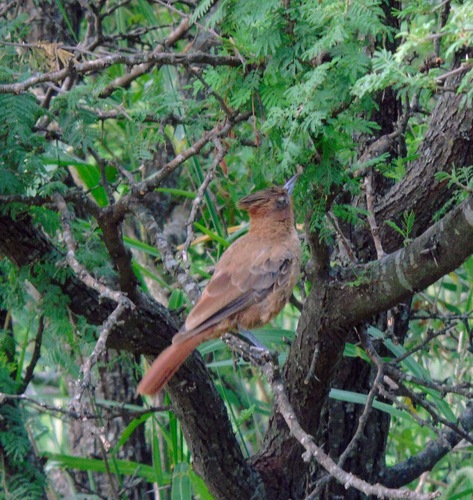
The brown cacholote ranges from 24 to 26 cm (9.4 to 10 in) in length and weighs 63 to 79 g (2.2 to 2.8 oz), making it one of the largest furnariids. The entire bird is rufous, with varying shades in different areas. The area between the eye and nostrils is slightly darker, alongside the bottom of the tail feathers. The breast is lighter in color compared to the throat, which is especially vibrant. The feathers on the top of the head (the crest) resembles that of a jay and is especially dark, along with the primary and secondary flight feathers.
Text from Wikipedia, licensed CC BY-SA 4.0.
When to see the Brown Cacholote
One bar for each month, and every month is filled: this bird is recorded here in all twelve. The wide bar is October, the month with the most records.
Where to see the Brown Cacholote
The map shades 5 countries with regular records. Everything unshaded has no records. Countries are listed below the map.
About the Brown Cacholote
The brown cacholote is a medium-sized bird of the ovenbird family Furnariidae. It was described by Ludwig Reichenbach in 1853, with its subspecies, argentina, described in 1960 by Kenneth Carroll Parkes. It is nonmigratory, and is found in the forests and parks of Argentina, Bolivia, Brazil, Paraguay, and Uruguay. Unlike many other birds, the brown cacholote builds large, pitcher-like nests year-round, each weighing many times more than the bird itself. Breeding begins in mid-November, with both parents sharing the responsibility for taking care of the nest equally. Incubation takes 17–20 days, and nestlings fledge at 19 days.
Text adapted from Wikipedia, licensed CC BY-SA 4.0.
Easily confused with
 Grey-crested CacholotePseudoseisura unirufaThe grey-crested cacholote is 20 to 21 cm (7.9 to 8.3 in) long and weighs 42 to 57 g (1.5 to 2.0 oz).
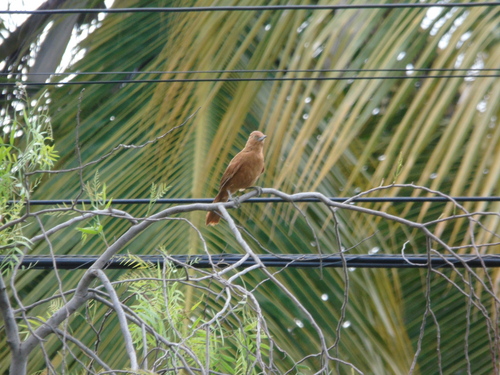 Caatinga CacholotePseudoseisura cristataThe Caatinga cacholote is 25 to 26 cm (9.8 to 10 in) long.
 White-throated CacholotePseudoseisura gutturalisThe white-throated cacholote is 22 to 23 cm (8.7 to 9.1 in) long and weighs 63 to 79 g (2.2 to 2.8 oz).
Side by side: Brown Cacholote vs Grey-crested Cacholote · Brown Cacholote vs Caatinga Cacholote · Brown Cacholote vs White-throated Cacholote
Learn the Brown Cacholote in the BeakBrain App
Photo and call practice. Coming soon to iPhone and Android.
Play today's Daily BirdEvery photo and recording on this page is credited to its author under the licence shown. Spotted a problem with this page, or have a better photo? Contribute.