Learn what every symbol on the card means.Full credits and sources at beakbrain.com/symbols
 WetlandCavity nestLarge · 397 g


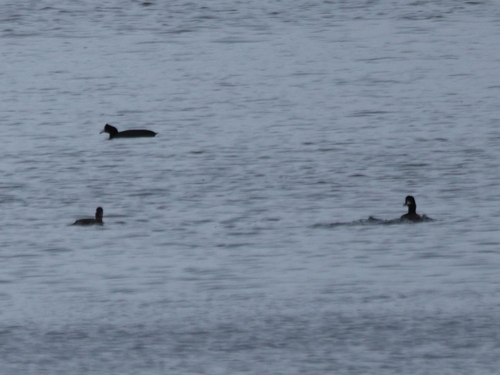
ID tip
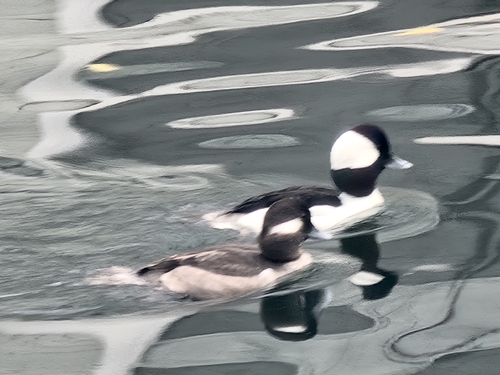
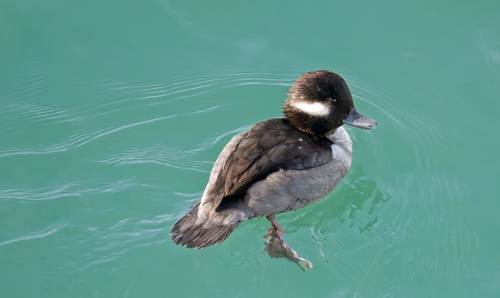
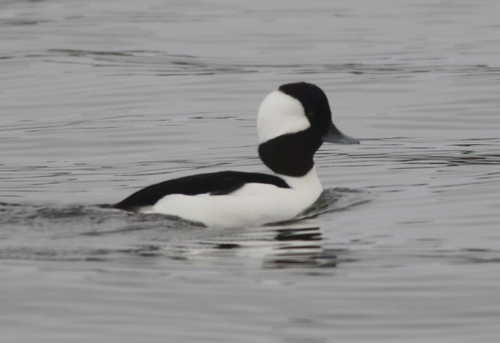
The bufflehead ranges from 32–40 cm (13–16 in) long and weighs 270–550 g (9.5–19.4 oz), with the drakes larger than the females. Averaging 35.5 cm (14.0 in) and 370 g (13 oz), it rivals the green-winged teal as the smallest American duck. The bufflehead has a wingspan of 21.6 in (55 cm). Adult males are striking black and white, with iridescent green and purple heads and a large white patch behind the eye. Females are grey-toned with a smaller white patch behind the eye and a light underside.
Text from Wikipedia, licensed CC BY-SA 4.0.
When to see the Bufflehead
One bar for each month. Filled bars are the 7 months with records; pale bars are months with none. The wide bar is January, the month with the most records.
Where to see the Bufflehead
The map shades 15 countries with regular records, and 13 more in a lighter tone where the bird turns up only as a stray. Everything unshaded has no records. Countries are listed below the map.
Recorded as a rare visitor in Sweden, Norway, Spain, France, Germany, Belgium, Cuba, South Korea, St. Martin, Austria, Czechia, Hungary, Russia.
About the Bufflehead
The bufflehead is a small sea duck of the genus Bucephala, the goldeneyes. It breeds in Alaska and Canada and migrates in winter to southern North America. This species was first described by Carl Linnaeus in his landmark 1758 10th edition of Systema Naturae as Anas albeola.
Text adapted from Wikipedia, licensed CC BY-SA 4.0.
Easily confused with
 Common GoldeneyeBucephala clangulaAdult males range from 45–51 cm (18–20 in) and weigh approximately 1,000 g (2.2 lb), while females range from 40–50 cm (16–20 in) and weigh approximately 800 g (1.8 lb).
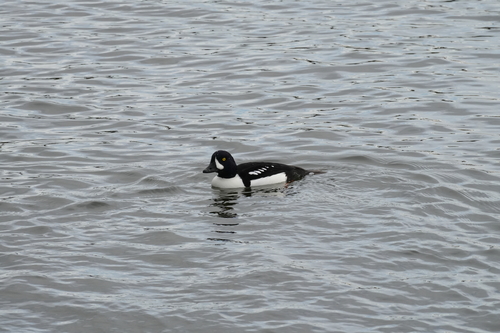 Barrow's GoldeneyeBucephala islandicaAdults are similar in appearance to the common goldeneye.
Side by side: Bufflehead vs Common Goldeneye · Barrow's Goldeneye vs Bufflehead
Learn the Bufflehead in the BeakBrain App
Photo and call practice. Coming soon to iPhone and Android.
Play today's Daily BirdEvery photo and recording on this page is credited to its author under the licence shown. Spotted a problem with this page, or have a better photo? Contribute.