Learn what every symbol on the card means.Full credits and sources at beakbrain.com/symbols
 GrasslandPlatform nestHuge · 1.7 kg



ID tip
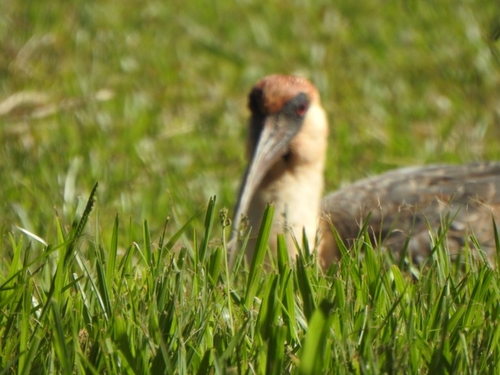
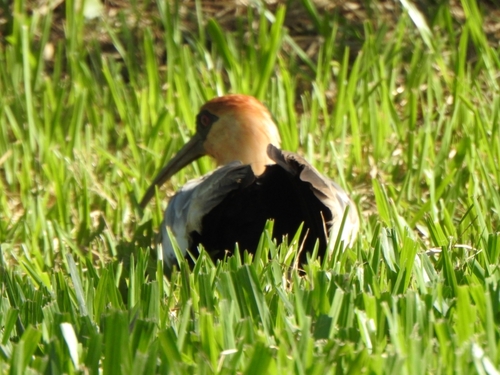
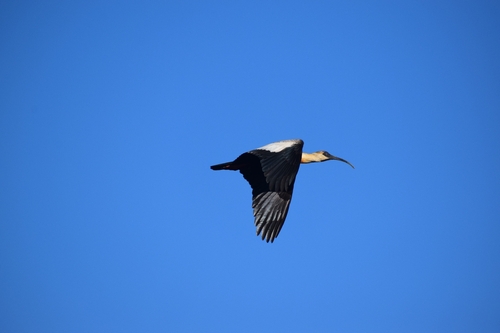
It has a total length of approximately 75 centimetres (30 in). The neck is buffish, the upperparts are grey, the belly and flight feathers are black, and there is a large white patch in the wings. In flight, where the relatively short legs do not extend beyond the tail (unlike e.g. Eudocimus and Plegadis), the white patch forms a broad white band on the upperwing that separates the black remiges and the grey lesser wing-coverts. The bill and bare skin around the eyes are blackish and the legs are red.
Text from Wikipedia, licensed CC BY-SA 4.0.
When to see the Buff-necked Ibis
One bar for each month, and every month is filled: this bird is recorded here in all twelve. The wide bar is October, the month with the most records.
Where to see the Buff-necked Ibis
The map shades 8 countries with regular records, and 2 more in a lighter tone where the bird turns up only as a stray. Everything unshaded has no records. Countries are listed below the map.
Recorded as a rare visitor in French Guiana, Peru.
About the Buff-necked Ibis
The buff-necked ibis, also known as the white-throated ibis, is a fairly large ibis found widely in open habitats of eastern and northern South America. It formerly included the similar black-faced ibis as a subspecies, but that species is almost entirely restricted to colder parts of South America, has a buff lower chest, and lacks the contrasting large white wing-patches.
Text adapted from Wikipedia, licensed CC BY-SA 4.0.
Easily confused with
 Black-faced IbisTheristicus melanopisIt has a total length of approximately 75 centimetres (30 in).
 Plumbeous IbisTheristicus caerulescensThis large ibis measures 71–77 cm in length, with a wing length of 397-450mm in males and 360-406mm in females.
Andean IbisTheristicus branickiiIt has a total length of approximately 75 centimetres (30 in).
Plumbeous IbisTheristicus caerulescensThis large ibis measures 71–77 cm in length, with a wing length of 397-450mm in males and 360-406mm in females.
Andean IbisTheristicus branickiiIt has a total length of approximately 75 centimetres (30 in).
Side by side: Buff-necked Ibis vs Green Ibis · Black-faced Ibis vs Buff-necked Ibis · Buff-necked Ibis vs Plumbeous Ibis
Learn the Buff-necked Ibis in the BeakBrain App
Photo and call practice. Coming soon to iPhone and Android.
Play today's Daily BirdEvery photo and recording on this page is credited to its author under the licence shown. Spotted a problem with this page, or have a better photo? Contribute.