Learn what every symbol on the card means.Full credits and sources at beakbrain.com/symbols
 ForestDomed nestSmall · 19 g







What the Buff-breasted Wren sounds like


ID tip
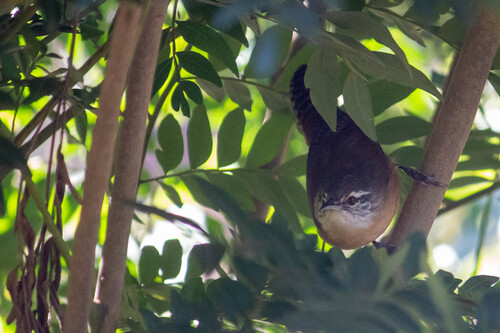
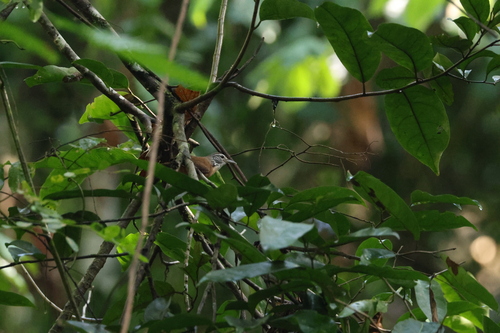
Male buff-breasted wrens weigh 18.5 to 22.8 g (0.65 to 0.80 oz) and females are lighter at 16.0 to 19.5 g (0.56 to 0.69 oz), but the sexes are otherwise similar. There is considerable variation in plumage across the species' wide range. Adults' head, nape, shoulders, tail, and back are rufescent to grayish brown; the tail is heavily barred. The throat, supercilium, and the rest of the face range from whitish through gray to gray-brown. The chest is buffy and the belly more cinnamon. Fledglings are duller overall than adults and the buff of their chest is paler. Voice: Both male and female buff-breasted wrens have large song repertoires. Often a male will begin a song and the female will complete it. They also have a variety of calls.
Text from Wikipedia, licensed CC BY-SA 4.0.
When to see the Buff-breasted Wren
One bar for each month, and every month is filled: this bird is recorded here in all twelve. The wide bar is October, the month with the most records.
Where to see the Buff-breasted Wren
The map shades 11 countries with regular records. Everything unshaded has no records. Countries are listed below the map.
About the Buff-breasted Wren
The buff-breasted wren is a species of bird in the family Troglodytidae. It is found in the Amazon Basin of northern Brazil and Amazonian Colombia, Ecuador, Peru and northern-border Bolivia, and also the Guianan countries of Guyana, Suriname, and French Guiana. It occurs in non-Amazonian regions of Venezuela and Colombia and its range extends into eastern Panama.
Text adapted from Wikipedia, licensed CC BY-SA 4.0.
Easily confused with
 Bay WrenCantorchilus nigricapillusThe bay wren is 12.6 to 15.6 cm (5.0 to 6.1 in) long.
 Stripe-breasted WrenCantorchilus thoracicusThe stripe-breasted wren is 11.5 to 12.5 cm (4.5 to 4.9 in) long and has a mean weight of 17.6 g (0.62 oz).
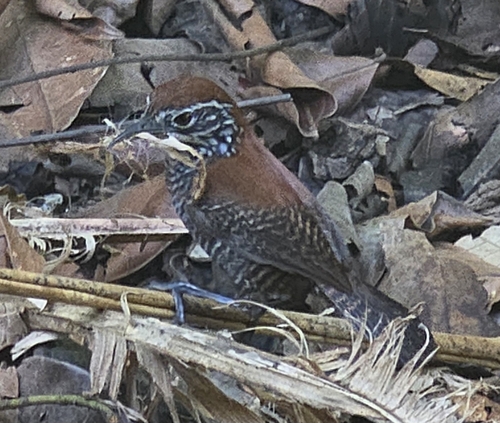 Riverside WrenCantorchilus semibadiusThe riverside wren is 13 to 14 cm (5.1 to 5.5 in) long and weighs 17 g (0.60 oz).
Side by side: Bay Wren vs Buff-breasted Wren · Buff-breasted Wren vs Stripe-breasted Wren · Buff-breasted Wren vs Riverside Wren
Learn the Buff-breasted Wren in the BeakBrain App
Photo and call practice. Coming soon to iPhone and Android.
Play today's Daily BirdEvery photo and recording on this page is credited to its author under the licence shown. Spotted a problem with this page, or have a better photo? Contribute.