
Bay Wren
Cantorchilus nigricapillus
The bay wren is 12.6 to 15.6 cm (5.0 to 6.1 in) long. Eight specimens from Panama weighed 17.7 to 26.3 g (0.62 to 0.93 oz). Adults of the nominate subspecies have a black face with a narrow white supercilium, a partial eyering, and a white patch at the back of the cheek. Their crown and nape are black and the rest of the upperparts are rich chestnut. The tail is a rich brown with bold black bars. The throat and breast are white, transitioning to rufous brown on the lower belly and flanks. Black bars cross the underparts from the breast to the vent area. Voice: The bay wren's song is loud, "a rapid repetition of clear, rich-toned, slurred, ringing whistles, trills, and warbles" sometimes given antiphonally. The species has a number of calls.
ID text from Wikipedia, CC BY-SA 4.0

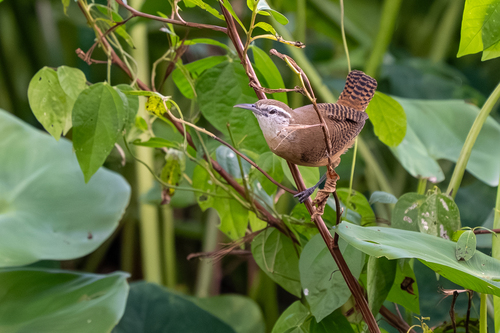
Buff-breasted Wren
Cantorchilus leucotis
Male buff-breasted wrens weigh 18.5 to 22.8 g (0.65 to 0.80 oz) and females are lighter at 16.0 to 19.5 g (0.56 to 0.69 oz), but the sexes are otherwise similar. There is considerable variation in plumage across the species' wide range. Adults' head, nape, shoulders, tail, and back are rufescent to grayish brown; the tail is heavily barred. The throat, supercilium, and the rest of the face range from whitish through gray to gray-brown. The chest is buffy and the belly more cinnamon. Fledglings are duller overall than adults and the buff of their chest is paler. Voice: Both male and female buff-breasted wrens have large song repertoires. Often a male will begin a song and the female will complete it. They also have a variety of calls.
ID text from Wikipedia, CC BY-SA 4.0

Where you might meet both
Learn this pair in the BeakBrain App
Photo and call practice. Coming soon to iPhone and Android.
Play today's Daily BirdPhotos and recordings are credited to their authors under the licence shown. Full profiles: Bay Wren and Buff-breasted Wren.